
A craving is not easy to ignore. You might suddenly want a drink, a cigarette, a drug, or something else you are trying to avoid. The longer you try to resist, the more you end up thinking about it. You may even begin to convince yourself that giving in will make the discomfort stop. Unfortunately, this is what leads to a slip or a relapse.
But it does not have to be this way.
Urge surfing is a mindfulness technique that enables you to experience a craving without giving into it. It is based on the concept that instead of fighting the urge, suppressing it, or giving in, you learn to observe it and allow it to change on its own.
The U.S. Department of Veterans Affairs (VA) writes that urges or cravings are like ocean waves. It slowly develops, reaches a peak, and eventually loses strength. You cannot always control when a wave comes in, but you can learn to ride it without floating away with it. Learning this technique takes practice. However, each time you experience an urge without automatically acting on it, you are creating an opportunity for yourself to respond differently – and this is the foundation.
What Is Urge Surfing?
Urge surfing is a coping technique that involves noticing a craving, observing the physical and emotional sensations connected with it, and allowing the urge to pass without acting on it.
The technique was introduced by psychologist Alan Marlatt as part of his work on relapse prevention, along with Dr. Judith Gordon. It draws on the principles of mindfulness, particularly observing thoughts, feelings, and bodily sensations without immediately reacting to them.
For instance, imagine you have stopped drinking but suddenly feel a strong desire for a drink after a stressful day. Your mind might tell you that a drink will help you relax. You may remember the familiar sensation of holding a drink or the relief that comes with it. So, instead of immediately reaching for one, you stop yourself.
You notice the craving. You pay attention to how your body feels. Perhaps your chest feels tight, your hands are restless, or your mouth feels dry. You observe these sensations without judging yourself or trying to force them away. You then allow the craving to rise and change while choosing not to act on it.
This technique is urge surfing. It is crucial to understand that the goal is not to eliminate cravings, but to change how you respond to them.
Why Do Cravings Feel So Difficult to Resist?
Urges or cravings involve physical sensations, emotions, memories, and learned associations with drugs and alcohol.
When you repeatedly engage in a particular behavior, your brain can begin connecting it with pleasure, comfort, relief, or escape. Over time, certain circumstances, persons, settings, or even emotions may trigger an urge to repeat that behavior. Even more so because psychoactive substances work by targeting the reward centers of your brain.
For someone recovering from substance use, an urge/craving might be triggered by:
- Experiencing stress, anxiety, loneliness, or boredom.
- Feeling overwhelmed after an argument or difficult day.
- Spending time with acquaintances or friends who still use substances.
- Encountering familiar smells, sounds, or other reminders of substance use.
- Visiting a place associated with previous drug or alcohol use.
- Experiencing withdrawal symptoms or physical discomfort.
The urge is often connected with immediate relief. However, acting on it may reinforce the same behavior you are trying to change.
Safety Note: If you experience withdrawal symptoms like high fever, confusion, tremors, and seizures, among others – seek medical care right away. Call 9-1-1 (U.S.) immediately.
You Do Not Have to Navigate Recovery On Your Own
Cravings can be difficult to manage, but the right care can make recovery easier. Reach out to our team today to explore personalized treatment programs and take the next step toward lasting recovery.
Call (866) 885-3042
How Does Urge Surfing Work?
The easiest way to understand urge surfing is to imagine an ocean wave.
A wave does not remain at the same height forever. It slowly builds, reaches its peak, and eventually loses momentum.
Cravings can behave similarly. Their intensity may fluctuate rather than remain constant.
Here is what happens during each stage:
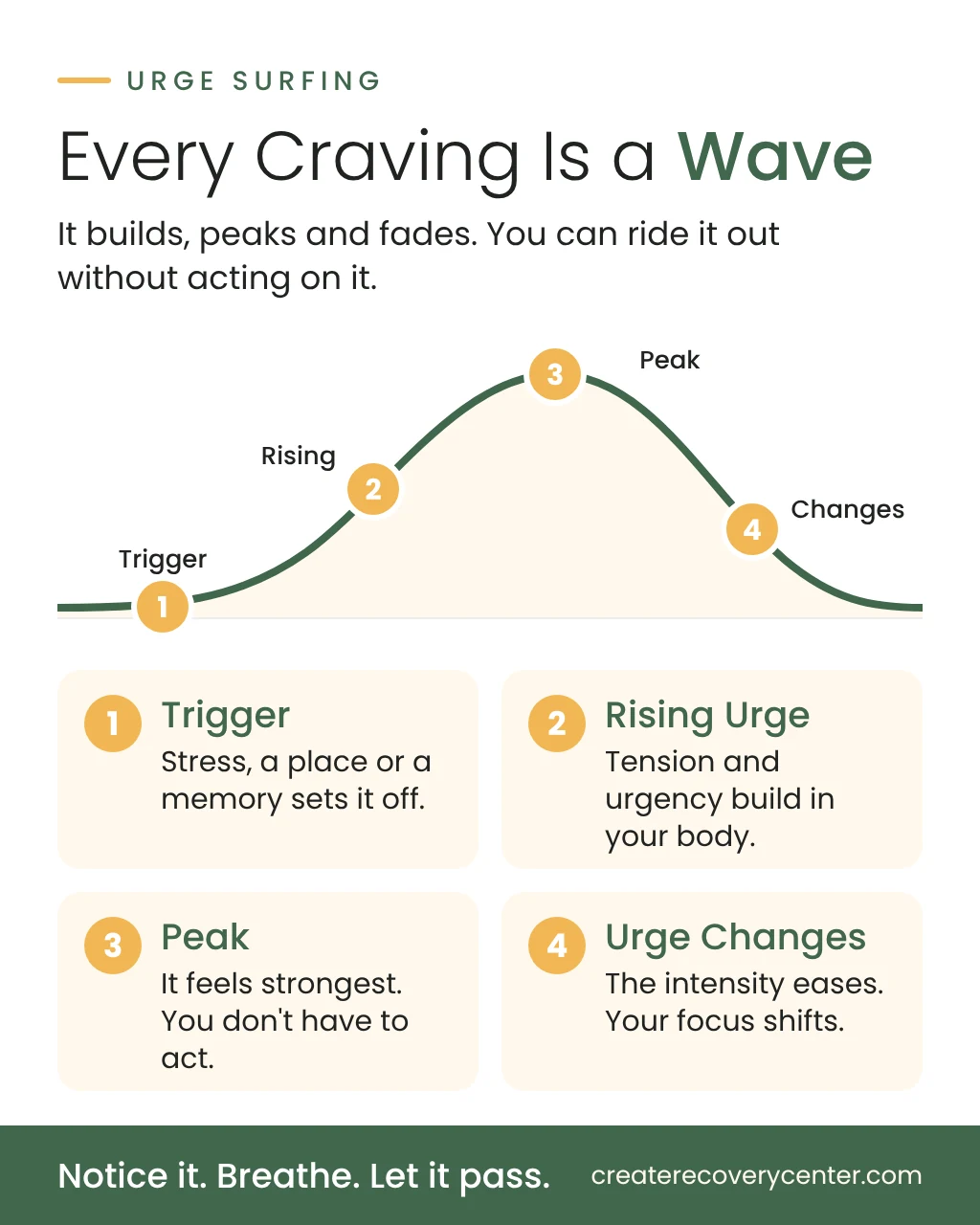
1. The Trigger: Something happens that brings the urge to your attention. It might be an emotion, a circumstance, a memory, or an environmental cue.
2. The Rising Urge: You begin experiencing a stronger desire to engage in the behavior. You might notice physical restlessness, tension, intrusive thoughts, or an increasing sense of urgency.
3. The Urge Reaches Its Peak: The craving may feel particularly intense. You might believe that you cannot tolerate it much longer or that acting on it is the only way to feel better.
4. The Urge Changes: With time, the intensity may decrease. The physical sensations might become less noticeable, your thoughts may become less persistent, or your attention may shift.
Not every craving follows a predictable pattern. Some urges return, fluctuate, or remain uncomfortable for longer than expected.
What is crucial here is that you do not have to act on an urge simply because it feels intense. You are learning to observe the experience rather than respond to it directly.
How to Practice the Urge Surfing Technique?
You can practice urge surfing techniques whenever you notice a craving or impulse. Here is how you do it – step-by-step:
Step 1: Stop and Acknowledge the Urge
When you notice a craving, resist the temptation to react immediately. Give yourself a moment before making a decision.
Instead of thinking, “I need to drink,” try saying, “I am noticing an urge to drink.”
This small change in how you speak to yourself can allow you to separate the experience of a craving from acting on it.
Do not criticize yourself for experiencing the urge. Cravings are a common occurrence while changing established behaviors, particularly during substance use recovery.
Step 2: Find a Comfortable Position
If possible, sit somewhere comfortable with your feet resting on the floor and your hands relaxed.
Take a few slow, comfortable breaths.
You do not need to force yourself to relax or make the craving disappear. Simply focus on the present moment.
If sitting quietly feels uncomfortable, you can practice while standing or walking slowly.
Step 3: Notice Where You Feel the Craving
Focus your attention on your body.
You might notice:
- Tightness in your chest.
- Dryness in your mouth.
- Restlessness in your hands or legs.
- Tension in your jaw.
- A sensation in your stomach.
- A feeling of strain or heaviness.
Try to notice the sensations without judging them or making them go away.
For instance, rather than thinking, “I cannot stand this feeling,” try to think, “My chest feels tight, and I notice a restless sensation in my hands.”
Step 4: Describe the Sensations
Choose one area in your body where the craving feels particularly strong.
Observe the sensation carefully.
Ask yourself:
- Does it feel hot or cold?
- Is it sharp, dull, or tingling?
- Does it feel heavy or light?
- Is it constant, or does it come and go?
- Is it spreading or becoming more concentrated?
- Does its intensity change when I breathe?
Only approach the sensation with curiosity, not judgment.
Step 5: Imagine the Urge as a Wave
Now imagine the craving as an ocean wave.
Picture yourself on a surfboard, allowing the wave to rise and fall beneath you. You simply stay with the experience and notice how it changes.
When your mind starts thinking about drinking or using a substance, or engaging in the behavior, gently bring your attention back to your body.
The urge might become stronger. It might weaken. It might shift from one part of your body to another.
Allow these changes to happen without treating them as instructions to act.
Step 6: Observe the Urge Without Acting on It
Keep paying attention to the craving.
You might find it helpful to rate its intensity from 0 to 10. Check the intensity again after a few minutes.
The number does not indicate success or failure. It simply means you are noticing how the experience changes.
Step 7: Decide What You Need Next
Once you have spent some time observing the urge, consider what you have to do to take care of yourself.
You might choose to:
- Observe the craving.
- Drink some water or have something to eat if you are hungry.
- Go for a brisk walk.
- Call someone you trust.
- Leave the environment connected with the behavior.
- Engage in an activity that requires your attention.
- Speak about the craving with your therapist or a recovery community like Alcoholics Anonymous, Narcotics Anonymous, or SMART Recovery.
You have created a gap between experiencing the urge and responding to it. Use the time to make a decision that fosters your recovery.
An Urge Surfing Script You Can Use During a Craving
Sometimes, knowing what to do is easier than knowing what to tell yourself when a craving really occurs.
An urge surfing script gives you simple prompts to follow when your thoughts feel overwhelming. Here is one you can use:
Right now, I am experiencing an urge.
↓
I do not need to act on it immediately.
↓
I am going to stop and notice what is happening.
↓
I can feel my body. I can notice my breathing. I can observe the sensations that come with this craving.
- Where do I feel it most strongly?
- What does it feel like?
- Is there tightness, restlessness, warmth, or tension?
↓
I do not need to judge these sensations or push them away.
↓
This is an urge. It is an experience I am having, not an instruction I have to follow.
↓
I imagine this craving as a wave. It may become stronger. It may reach a peak. It may change. I do not need to fight it. I can allow myself to experience this moment without acting on the urge. If my thoughts begin telling me that I need to give in, I will gently return my attention to my breathing and the sensations in my body. I can take this one moment at a time. I do not have to make the discomfort disappear before I make a healthy choice.
↓
For now, I am going to stay with this experience and allow myself time to decide what I need next.
You can repeat the script whenever needed. With practice, you may become more comfortable using similar scripts without reading them.
Urge Surfing Worksheet: Track and Understand Your Cravings
An urge surfing worksheet can help you recognize patterns in your cravings and understand what happens when you choose not to act on them. Recording your experiences can also help you identify circumstances that make urges stronger and coping strategies that work for you.
Use the following worksheet after experiencing a craving.
1. Identify the Trigger
What happened immediately before the craving?
Consider the circumstance, people around you, your environment, and your emotional state of mind.
For instance: I had a stressful conversation at work and immediately wanted a drink.
My trigger:
2. Identify the Urge
What did you feel like doing?
For instance: I wanted to pour myself a drink.
The urge I experienced:
3. Rate the Intensity
How strong was the craving?
| Time | Urge intensity (0 to 10) |
|---|---|
| When I first noticed it | ____ |
| After a few minutes | ____ |
| After observing the urge | ____ |
| When I finished the exercise | ____ |
4. Notice Your Physical Sensations
Where did you experience the craving?
What did it feel like?
For instance: I noticed tightness in my chest and dryness in my mouth.
What I noticed in my body:
5. Identify Your Thoughts and Emotions
What thoughts came into your mind? What emotions accompanied the craving?
For example: I thought that drinking would help me calm down. I also felt frustrated and overwhelmed.
My thoughts and emotions:
6. Record What You Did
Did you practice urge surfing? Did you use another coping strategy?
For instance: I sat quietly, observed my breathing, and paid attention to the physical sensations instead of immediately reaching for a cigarette.
What I did:
7. Reflect on the Experience
- What did you learn about the craving?
- Did its intensity change?
- What helped you manage it?
For instance: I realized that the craving was particularly strong immediately after stressful conversations. Taking a break and calling a friend helped me manage the discomfort.
What I learned:
You can complete this worksheet whenever you experience a craving. Over time, your observations may allow you to recognize recurring triggers, understand your responses, and prepare for difficult circumstances.
Urge Surfing and DBT: How Are They Connected?
Urge surfing is a skill you learn in mindfulness-based and dialectical behavior therapy modalities to manage difficult emotions and impulses.
DBT is a psychotherapy that teaches people skills to manage intense emotions, tolerate distress, improve relationships, and respond more effectively to challenging situations.
Urge surfing uses principles of DBT mindfulness skills, particularly observing and describing experiences without judgment.
Another skill crucial to DBT is distress tolerance. Distress tolerance skills allow you to experience uncomfortable sensations and emotions without immediately engaging in behaviors that might create more problems.
This is where urge surfing DBT practices can be useful. Rather than treating an uncomfortable feeling as something that must be eliminated, you learn to acknowledge it and tolerate its presence.
It is pertinent to remember that urge surfing is one coping skill, not a complete treatment for substance use or other mental health conditions. A therapist can help you determine how to incorporate it into a broader treatment plan.
What If the Craving Does Not Go Away?
Urge surfing does not always guarantee that every craving will disappear. Sometimes, you may practice the technique for several minutes and still feel a strong desire to engage in the behavior. This does not mean you have failed.
The purpose of urge surfing is not to make every urge disappear. It is to allow you to experience an urge without directly acting on it. If the craving remains intense, consider combining urge surfing with other coping strategies.
- Change Your Environment: If you are in a place connected with substance use or another unwanted behavior, move somewhere safer.
- Distract Yourself: Redirecting your attention can be useful. Try taking a walk, preparing a meal, or speaking to someone you trust.
- Reach Out for Support: You do not have to manage every craving alone. Contact a trusted family member, loved one, therapist, or recovery group.
- Practice Other Distress Tolerance Skills: If you are using DBT, your therapist may enable you to combine urge surfing with other distress tolerance techniques.
Learning Urge Surfing and Other Coping Skills
Recovery is not one skill. It is about a combination of skills that become the crux of your sober, healthier life going forward.
At Create Recovery Center, our structured partial hospitalization (PHP) and intensive outpatient (IOP) programs combine urge surfing with therapy, medication, and other coping skills that are personalized to your symptoms, history, and needs for a whole person healing experience.
Get Clarity On Your Recovery Options
You do not have to figure out everything before you have even called us. Reaching out can be the beginning of a conversation that becomes the first step to a lasting change. Our clinicians will sit with you to understand your symptoms, history, and goals to recommend the right level of care and skills for you in your healing journey.
Speak To Someone Who Understands
Frequently Asked Questions About Urge Surfing
1. How long does urge surfing take?
There is no fixed duration for urge surfing. You can begin by observing the craving for a few minutes and slowly increase the time as you become more comfortable.
2. Is urge surfing useful for every type of craving?
Urge surfing can be used for many types of impulsive thoughts and emotions, including cravings for alcohol, drugs, and nicotine, as well as certain behavioral urges.
3. Is urge surfing the same as resisting a craving?
Resisting a craving often involves trying to fight, suppress, or eliminate the urge. Urge surfing acknowledges the craving, observes the sensations connected with it, and allows the experience to change without acting on it.
4. Can beginners practice urge surfing?
Yes, you can begin by noticing when a craving occurs, identifying where you feel it in your body, and observing how it changes.
5. Can urge surfing prevent relapse?
Urge surfing may contribute to reducing the likelihood of acting on a craving, making it a useful component of relapse prevention. However, it cannot guarantee that relapse will not happen. A comprehensive recovery program also addresses triggers, stressors, underlying mental health reasons, and social support systems.