

Disclaimer: This article is for informational purposes only and is not meant to replace expert medical or mental health advice. If you find that alcohol use is becoming difficult to control, reach out to a board-certified physician or mental health specialist for advice and treatment. For emergencies or crises, call 9-1-1 or 9-8-8 (U.S.) immediately.
The main signs of alcoholism are needing more alcohol to feel the same effect, experiencing withdrawal symptoms when you stop, and being unable to cut back even when you want to. Behavioral health specialists call this pattern alcohol use disorder (AUD). It is diagnosed when at least 2 of 11 criteria are observed within 12 months, and it ranges from mild to severe.
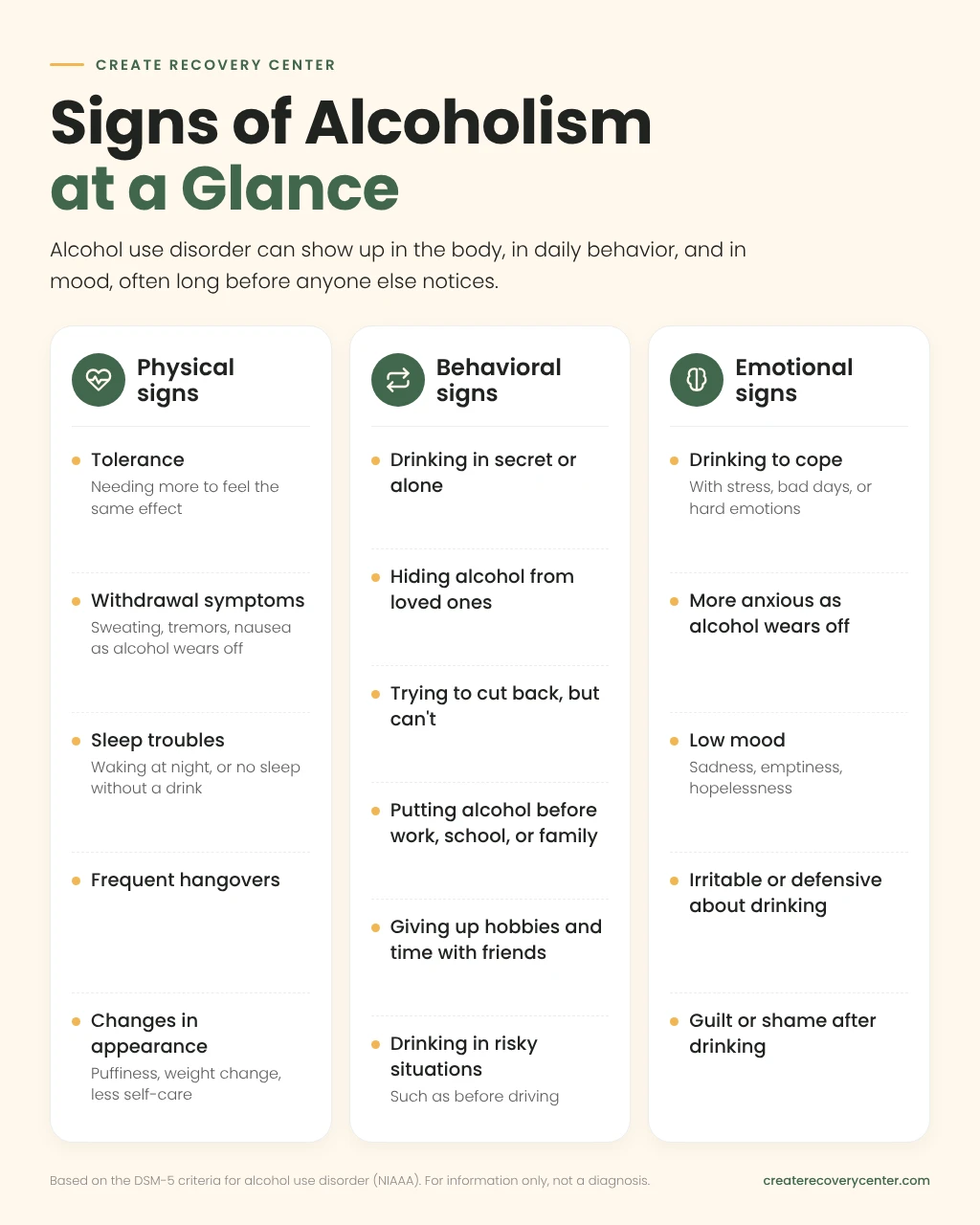
Physical Signs of Alcoholism
The symptoms of alcoholism often show up in the body first, even when a person looks fine to everyone else. These are the most common physical signs.
- Tolerance: Tolerance is when you need more alcohol to achieve the effect you used to. The National Institute on Alcohol Abuse and Alcoholism (NIAAA) says tolerance is one of the 11 Diagnostic and Statistical Manual of Mental Disorders (DSM-5) criteria for alcohol use disorder.
- Withdrawal Symptoms: When the alcohol wears off, you can experience vomiting, sweating, tremors, and sometimes even serious symptoms like delirium tremens and seizures. Some drink again just to make the feeling stop. Withdrawal is also one of the eleven criteria that DSM-5 lists for AUD.
- Sleep Troubles: It is a common misconception that alcohol leads to better sleep. However, the reality is that when you fall asleep after drinking, you may wake up in the night, or you may find it difficult to sleep at all on nights you skip alcohol.
- Frequent Hangovers: An occasional bad hangover in the morning is common. Regular hangovers can mean you are drinking more than your body handles well.
- Changes in Appearance: Some notice puffiness, weight changes, or a drop in self-care and personal hygiene. Many with AUD seem healthy on the outside, so appearance alone cannot be the entire story.
Please Note: For those who have been drinking heavily for a long time, reducing alcohol or stopping suddenly can be dangerous, as it can lead to serious withdrawal symptoms. If someone experiences severe confusion, a seizure, or hallucinations after stopping alcohol, call 9-1-1 immediately.
Behavioral Signs of Alcoholism
Behavioral signs of an alcoholic are one of the first signs that become evident:
- Drinking in secret or alone. Hiding, lying, and secretive behaviors become common.
- Hiding alcohol in places where loved ones cannot find it
- Trying to cut back on alcohol, but being unable to.
- Prioritizing alcohol use over education, job, and family.
- Giving up on things one used to enjoy. Hobbies, time with family and friends, etc, take a backseat as alcohol use takes over.
- Drinking in risky circumstances – such as while driving or operating heavy machinery.
- Continuing to drink despite physical, psychological, and behavioral problems.
Emotional and Mental Signs
Alcohol is closely tied to emotional and mental health, so here are some signs that alcoholism is being driven by underlying emotional and mental health reasons:
- Drinking to cope – where alcohol becomes the coping tool to handle bad days or difficult emotions.
- Feeling more anxious than is common for the person, especially as the effect of alcohol wears off.
- Experiencing low mood – feelings of sadness, emptiness, and hopelessness, as drinking can worsen depressive symptoms.
- Feeling irritable, where the person snaps easily or becomes defensive – especially about drinking.
- Experiencing guilt or shame regarding drinking.
Drinking and mental health often overlap. At Create Recovery Center, we treat substance use, mental health conditions, or both together under an integrated dual diagnosis program for a well-rounded path to recovery.
Not Sure If Your Drinking Is a Problem Yet?
If you are not sure what your drinking patterns are beginning to feel like, you can schedule a confidential call with Create Recovery’s team. We will listen to what you are experiencing and what you need to suggest the best next step for you.
Call (866) 885-3042
Early Signs vs. Late Signs of Alcoholism
While the DSM-5 itself does not list early or late signs of alcoholism, alcoholism does not develop overnight. It develops gradually, as one progresses from one stage to the other. The early signs are almost easy to explain away, whereas the later signs become more evident. Nonetheless, it is crucial to be aware of both to spot them early and seek treatment early.
| Early Signs of Alcoholism | Later Signs of Alcoholism |
|---|---|
| Needing more drinks to feel the same effect | Strong cravings that are difficult to ignore |
| Drinking more than you planned | Repeated unsuccessful attempts to cut back or stop |
| Using alcohol to relax or cope with stress | Needing alcohol just to feel normal |
| Thinking of how and when to get your next drink | Anxiety, irritability, vomiting, shakiness, or sweating, as alcohol wears off |
| Regular hangovers | Missed school, work, or canceled plans |
| Drinking a bit before social events | Drinking alone, in secret, or in risky circumstances |
| Brushing off a loved one’s concern | Continuing to drink despite health or relationship problems |
If a few or more of these symptoms on either side feel familiar to you, it might be a good time to have a confidential conversation with a licensed clinician who will sit with you to understand your symptoms, history, and needs to suggest the next best step forward for you.
What Is the Difference Between an Alcoholic and a Heavy Drinker?
An alcoholic vs heavy drinker can look alike from the outside. The difference comes down to amount versus control.
Heavy drinking basically refers to the quantity of alcohol. The Centers for Disease Control and Prevention (CDC) defines heavy drinking as 8 or more drinks per week for women and 15 or more per week for men. It defines binge drinking as 4 or more drinks on one occasion for women and 5 or more for men. A standard drink is 12 ounces of beer, 5 ounces of wine, or 1.5 ounces of liquor.
Alcohol use disorder, or alcoholism, is about a lack of control and consequences. It is diagnosed by symptoms, such as trouble cutting back, cravings, withdrawal, and drinking despite negative consequences, not just by quantity.
Signs of a High-Functioning Alcoholic
One of the most dangerous things about alcoholism is high-functioning alcoholism. It looks like nothing from the outside, but it does not mean that everything is fine underneath the perfect exterior.
Having a job, a home, and a good reputation does not always rule out alcohol use disorder.
Some keep up appearances while drinking every day, relying on alcohol to unwind, or getting defensive when drinking comes up.
High-functioning alcohol use is when a person is functioning from the outside, but is experiencing a pattern that is consistent with alcoholism. If drinking feels more difficult to control than it used to, even if the person is still functioning, it may indicate an AUD. This is why it is crucial to reach out early before the pattern can further take root.
When to Get Help (and What Outpatient Treatment Looks Like)?
You do not need to be in a crisis to reach out. Considering the care you need and deserve is the first step to a life-changing recovery journey.
Create Recovery Center is an outpatient treatment center for substance use, mental health conditions, or both. You do not have to put your life on hold to focus on your recovery; you can do both:
- A partial hospitalization program (PHP) offers daily structure for 6 to 8 hours a day, 5 days a week, and you return home in the evening.
- An intensive outpatient program (IOP) runs 9 to 15 hours a week, which means that you can attend morning, afternoon, or evening sessions, and maintain your daily life.
Whether you need structured care for yourself or for someone you love, our team can sit with you in confidential settings to understand your symptoms, history, and needs to craft a personalized treatment program for you.
If you need medically supervised detox before beginning outpatient treatment, Create Recovery can coordinate with trusted detox partners and continue your treatment once you are safe and stabilized.
Reaching out does not mean you have to commit to anything right away. It is only an information-gathering step to understand where you stand and what the next step in your healing journey can be.
Care That Meets You Where You Are
Explore options that can fit into your schedule and make things feel more manageable – without overwhelming your day-to-day life.
Speak With Experts Who Understand
Frequently Asked Questions About the Signs of Alcoholism
1. What are the 11 signs of being an alcoholic?
The DSM-5 lists 11 signs of alcohol use disorder or alcoholism:
- Strong cravings or urges to use alcohol
- Drinking more frequently and heavily than intended
- Trying to cut back or stop alcohol use, but not being able to
- Spending a lot of time drinking or recovering from its effects
- Prioritizing alcohol over education, career, or family
- Giving up on activities one used to enjoy in favor of alcohol use
- Continuing to use alcohol despite its negative effects on physical and mental health
- Continuing to drink despite interpersonal conflicts with family and friends
- Drinking in high-risk circumstances, such as driving or operating heavy machinery
- Experiencing tolerance – which is when the person needs more alcohol to achieve the desired effect
- Experiencing withdrawal symptoms upon abruptly reducing or stopping alcohol use
2. What are the five symptoms of an alcoholic?
Five common symptoms are strong cravings, needing more alcohol to feel its effects, withdrawal when you stop, trouble cutting back despite trying, and continuing to drink despite the negative consequences on safety, health, and relationships.
3. What is the difference between an alcoholic and a heavy drinker?
Heavy drinking refers to the quantity of alcohol. Alcohol use disorder is about loss of control and consequences, such as trouble cutting back or drinking despite negative consequences.
4. Can you be an alcoholic and still function at work?
A high-functioning alcoholic can meet the criteria for alcohol use disorder and still function normally from the outside – like showing up for work and other responsibilities.
5. Is drinking every night a sign of alcoholism?
Not always necessarily on its own, but it is worth paying closer attention to. Explore why the person is drinking every night – to unwind, cope, etc.