
Disclaimer: This article is for informational purposes only and is not meant to replace expert medical or mental health advice. If you find that alcohol use is becoming difficult to control, reach out to a licensed clinician for advice and treatment. For emergencies or crises, call 9-1-1 or 9-8-8 (U.S.) immediately.
The stages of alcoholism describe how drinking can change over time – from social drinking to dependence. The most common model, the Jellinek Curve, has four stages: pre-alcoholic, early, middle, and end-stage. These stages allow you to understand how one can experience alcohol use disorder (AUD) as something that does not happen overnight, but develops slowly and begins to take over one’s life.
Some may stay in one stage for years. Others skip a stage or move back and forth. Only licensed addiction medicine specialists and clinicians can tell you whether you or someone you love has AUD.
The National Institute on Alcohol Abuse and Alcoholism (NIAAA) characterizes AUD as a spectrum. It can be mild, moderate, or severe, depending on how many of the 11 symptoms a person has.
The 4 Stages of Alcoholism at a Glance
Here is a quick look at the four stages in the Jellinek Curve:
- Stage 1: The pre-alcoholic stage. Drinking to relax or cope, with tolerance beginning to develop.
- Stage 2: The early alcoholic stage. Blackouts, secret drinking, and frequent thoughts about acquiring and drinking alcohol.
- Stage 3: The middle alcoholic stage. Career, relationships, and health begin to suffer, and others notice.
- Stage 4: The end-stage. Serious health risks, and medical detox is needed before treatment.
The Jellinek curve shows these four stages as drinking worsens over time. Then comes the rehabilitation phase, which we shall cover later in the article.
No Matter Where You Are, Recovery Can Be Your Reality
It does not matter which stage of alcoholism feels familiar to you; it is never too early to reach out. At Create Recovery Center, our team will understand your concerns and recommend the best next step in your healing journey that is right for you.
Call (866) 885-3042
Stage 1: Pre-Alcoholic Stage
In the first stage, drinking looks like anyone else’s. You might have a drink after dinner or with your friends. Over time, alcohol can shift from something social to something you rely on to relax, cope with stress, or feel at ease during social events.
Common signs are:
- Drinking to unwind or manage stress
- Needing a little more alcohol to achieve the same effect, which is the beginning of tolerance
- Looking forward to the first drink of the day more than you used to
Learning these symptoms early is crucial to recognizing them as warning signs so that you reach out to make a change early. At this stage, a conversation with a licensed clinician or a counselor can allow you to take steps before alcohol takes over aspects of your life.
Stage 2: Early Alcoholic Stage
In the early stage, drinking starts to take up more space in your life, and the signs often are:
- Blackouts, which are gaps in memory for events that happened while drinking
- Secret drinking, or hiding how much you drink
- Thinking about acquiring and consuming alcohol often
- Tolerance that keeps rising
These are some signs that drinking is impacting the brain, even if your day otherwise feels fine.
Many may also feel guilt or shame here and promise themselves they will cut back. Wanting to cut down and not being able to is one of the 11 AUD symptoms as per the Diagnostic and Statistical Manual of Mental Disorders (DSM-5-TR).
Stage 3: Middle Alcoholic Stage
By the middle stage, drinking is becoming difficult to hide. Career, relationships, and health begin to suffer, and your loved ones begin to notice.
Common signs are:
- Missing school, work, or falling behind in your performance
- Arguments with family or friends about drinking
- Giving up activities you used to enjoy
- Drinking despite its impact on your physical and mental health
- Experiencing withdrawal symptoms when alcohol effects begin to wear off, such as shakiness, nausea, sweating, or trouble sleeping
If these sound familiar to you, treatment that focuses on your physical and emotional recovery from alcohol use is worth looking into.
Stage 4: End-Stage Alcoholism
End-stage alcoholism, sometimes called stage 4 of alcoholism, is the most serious point on the Jellinek Curve. Drinking has taken over daily life, and it has begun to seriously impact your brain and body.
NIAAA warns that long-term alcohol misuse can lead to permanent liver, heart, or brain damage. It raises the risk of cardiovascular disease, stomach bleeding, and several cancers.
At this stage, one may often experience constant cravings, strong withdrawal symptoms, ongoing health problems, and major conflicts at school, work, and in relationships.
The solution, here, is not to quit cold turkey. Do not stop drinking on your own. When the body depends on alcohol, stopping abruptly can lead to dangerous withdrawal, and delirium tremens and seizures are among the likely symptoms. So, medically supervised detoxification (detox) comes first.
Safety Note: Alcohol withdrawal is a serious condition that can become life-threatening in the absence of immediate medical attention. Call 9-1-1 immediately if someone is experiencing confusion, high fever, irregular heartbeat, psychosis, or seizures.
The Jellinek Curve: The Way Back Up
The four stages above come from the Jellinek Curve. The first half of the curve (crucial and chronic phase) indicates how drinking can worsen over time. However, this is not where it ends.
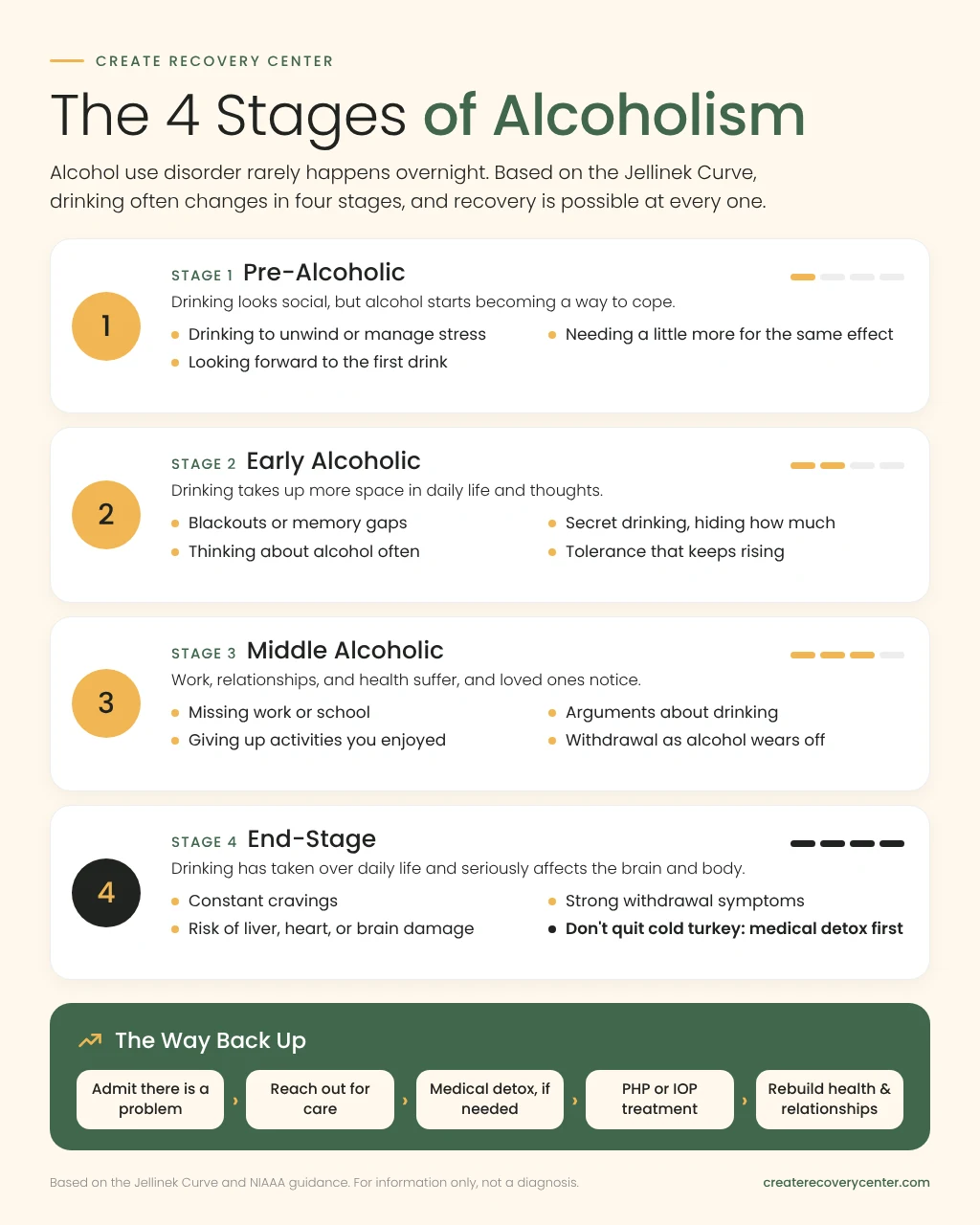
On the recovery side of the Jellinek curve, common milestones begin with admitting there is a problem, reaching out for the care you need and deserve, stopping drinking, and slowly rebuilding physical and mental health, relationships, and daily routines that contribute to a healthier life.
NIAAA also warns that alcohol use disorder is a chronic condition. Meanwhile, the National Institute on Drug Abuse (NIDA) says that relapse rates in substance use disorders can be as high as 40% to 60%. So, a setback does not mean you are doing something wrong or that treatment has failed.
It means you need to get in touch with your doctor or therapist to focus on your recovery principles and goals.
What Treatment Fits Each Stage?
The right level of care for alcohol use disorder, no matter what the stage, can only be suggested by a licensed and experienced clinician after a comprehensive clinical assessment or a psychiatric evaluation.
However, generally speaking, it looks like this:
Stages 1 to 3: Outpatient Care Can Be the Best Fit
Outpatient therapy, intensive outpatient programs, and partial hospitalization programs are among the evidence-based treatment options for AUD. At Create Recovery Center, we offer the following:
- A partial hospitalization program (PHP) that runs 6 to 8 hours a day, 5 days a week.
- An intensive outpatient program (IOP) that runs 9 to 15 hours a week.
- Evening IOP offers the same kind of care as IOP for those who study or work during the day.
Under PHP and IOP, you will typically receive:
- Individual therapy
- Group therapy
- Medication-assisted treatment and medication management (if required)
- Skills training
- Relapse prevention planning
- Lifestyle modifications
- Peer community
- Aftercare
- Practical recovery case management services
Create Recovery also treats substance use, mental health conditions, or both, which is called dual diagnosis. That matters at stage 3, when drinking and mental health concerns can often overlap and feed off of each other.
Stage 4: Detox First, Followed by PHP or IOP
Medical detox is where board-certified physicians and psychiatric practitioners treat the symptoms of alcohol withdrawal to ensure your safety and stability before you begin outpatient treatment. At Create Recovery, we do not offer medical detox, but we can refer you to trusted detox partners. Once detox is complete, you can begin a PHP or IOP program with us to continue care while living at home.
You Do Not Have to Wait to Reach Out
You do not have to wait until a breaking point or a crisis to reach out for the care you need and deserve for alcohol use disorder. Reaching out early leads to the best outcomes.
At Create Recovery Center, our licensed and experienced clinical team will sit down with you in confidential settings to understand your symptoms, history, and recovery goals to personalize treatment to meet you where you are in your healing journey.
Get Clarity On Your Options
Reaching out to us does not mean you have to commit to any program right away. It is just an information-gathering step to understand where you are, verify your insurance, and make decisions in your recovery at your own time.
Speak With Someone Who Understands
Frequently Asked Questions About the Stages of Alcoholism
What are the five stages of alcoholism?
The most common model has four stages: pre-alcoholic, early, middle and end-stage. Some others list five stages, by adding a recovery stage as well.
What are the 11 symptoms of alcohol use disorder?
The DSM-5 lists 11 signs of alcohol use disorder or alcoholism:
- Intense cravings and urges
- Drinking more, or for longer, than intended
- Being unable to cut back on alcohol use despite repeated attempts
- Devoting a lot of time to acquiring, drinking, and recovering from alcohol use
- Prioritizing alcohol use over career and loved ones
- Giving up on once enjoyable activities in favor of alcohol use
- Using alcohol despite physical and mental health concerns
- Using alcohol despite conflicts with family and friends
- Drinking in highly risky circumstances, like driving or operating heavy machinery
- Developing tolerance – needing more alcohol to achieve the desired effect over time
- Experiencing unpleasant and serious withdrawal symptoms upon suddenly reducing or stopping alcohol use
What is stage 4 of alcoholism?
Stage 4 of alcoholism, also called end-stage alcoholism, is when drinking takes over daily life and leads to serious health problems.
Can you stop drinking at any stage?
You can indeed stop drinking at any stage. Early attention to warning signs and quitting leads to the best outcomes. However, if you have begun to experience withdrawal symptoms, then a medical detox may be needed before you stop alcohol use; otherwise, it can lead to serious and even life-threatening emergencies.
Can outpatient rehab treat alcoholism?
Outpatient rehab options like partial hospitalization (PHP) and intensive outpatient (IOP) programs are evidence-based options that can treat alcoholism.