

The phrase wine mom sounds harmless because it is designed to. It turns drinking into a personality, a punchline, or a reward for surviving another exhausting day.
A stemless wine glass becomes part of the image. “Mommy needs wine” becomes a joke on a mug. Social media turns nightly drinking into something relatable rather than something worth examining.
But a marketing label cannot tell you whether your drinking is healthy.
It cannot diagnose alcohol use disorder. It cannot tell you whether you are drinking more than you intend to. And it cannot tell you whether alcohol has quietly become something you rely on to sleep, relax, manage stress, or get through motherhood.
That is why wine mom culture deserves a closer look.
If you have started wondering, “Am I an alcoholic?”, the answer cannot be determined by whether you identify with a meme. Alcohol use is better understood by looking at patterns, consequences, control, and the role alcohol plays in your life.
Deciding to Stop Does Not Risk Your Custody
One reason some mothers hesitate to change their drinking is fear.
What if admitting I have a problem makes me look like a bad parent?
What if asking for treatment brings CPS into the picture?
What if my family thinks I cannot handle motherhood?
Those concerns can be powerful enough to keep someone drinking.
But deciding to reduce or stop drinking is not, by itself, evidence that you are an unfit parent. Seeking help for alcohol use can be part of taking care of yourself and maintaining your ability to care for your children.
The legal consequences of a situation depend on the specific circumstances and applicable state and federal laws. A parent seeking treatment should not assume that simply acknowledging an alcohol problem automatically means losing custody.
If custody is already being contested, or if there are specific child-safety concerns, individualized advice from a qualified family-law attorney is more appropriate than relying on social media claims.
From a health perspective, there is also an important distinction between choosing to change your drinking and suddenly stopping heavy, prolonged alcohol use without medical guidance.
For people who have developed physical dependence, abruptly stopping alcohol can cause withdrawal that may become serious or life-threatening. Symptoms can include tremors, sweating, anxiety, nausea, rapid heart rate, seizures, and delirium.
If you drink heavily or regularly and are unsure whether stopping suddenly is safe, talk with a healthcare professional before attempting an abrupt stop.
Treatment does not have to mean disappearing from your children’s lives for a month.
Depending on your needs, support may include outpatient counseling, medication, peer support, intensive outpatient treatment, or other levels of care.
You can explore alcohol addiction treatment to understand the different approaches available.
Where Wine Mom Marketing Came From
The modern image of the drinking mother did not appear overnight.
Alcohol companies have long connected beverages with relaxation, celebration, femininity, social connection, and escape. More recently, parenting culture and social media have helped turn those messages into an identifiable character: the exhausted mother who deserves a drink at the end of the day.
The appeal is easy to understand.
Motherhood can involve repetitive responsibilities, little personal time, interrupted sleep, relationship stress, work demands, and enormous expectations.
A marketing message that says, essentially, You survived another day; you deserve a glass of wine can feel validating.
The problem begins when a product becomes part of the identity.
If drinking is framed as an expected part of being a modern mother, questioning it can feel like rejecting the entire culture around you.
You may hear things such as:
- “It’s just mom wine.”
- “I earned this.”
- “Every mom needs a glass.”
- “It’s cheaper than therapy.”
- “At least I don’t drink liquor.”
- “I only drink wine.”
None of these statements tells you how alcohol is affecting your health.
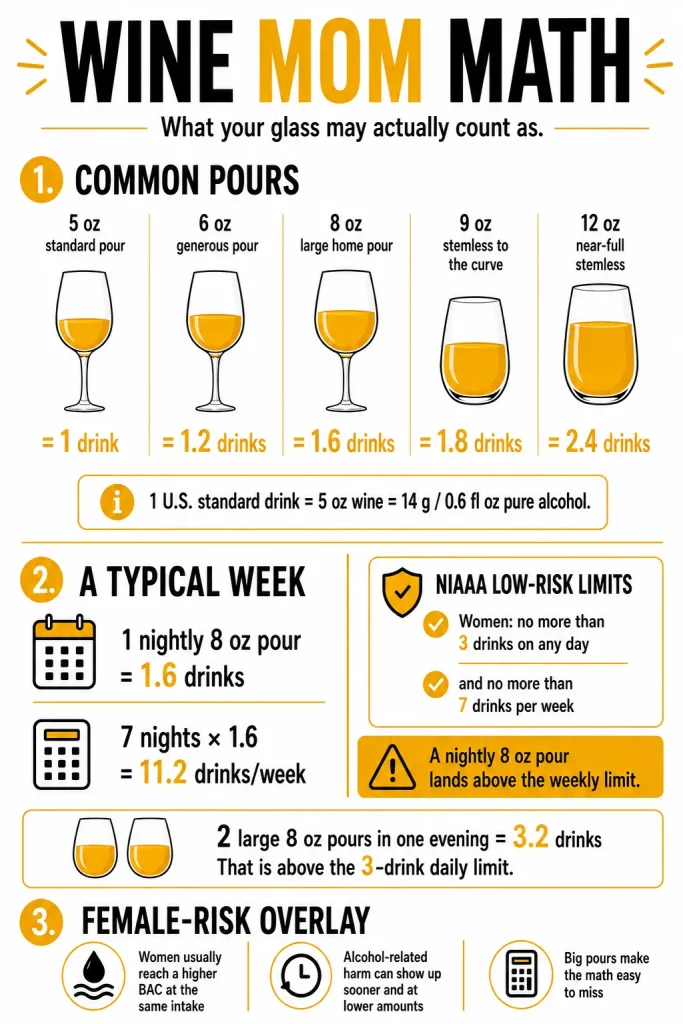
A glass can contain considerably more alcohol than people realize, depending on the pour. Large wine glasses and generous home pours can make it easy to consume more than one standard drink without thinking of it as multiple drinks.
NIAAA limits are based on standard drinks, not simply the number of glasses poured. For women, NIAAA defines heavy drinking as 4 or more drinks on any day or 8 or more drinks per week. In the United States, one standard drink contains about 14 grams of pure alcohol; for table wine, that is roughly 5 ounces at 12% alcohol. A generous home pour can therefore count as more than one standard drink.
That is one reason our infographic concept, Wine Mom Math, focuses on converting common pours and stemless glasses into standard drinks. The point is not to shame anyone. It is to make the amount visible.
What the Joke Hides About Female Risk
Alcohol affects women differently from men in several important ways.
One factor is body water composition.
On average, women tend to have less total body water relative to body weight than men. Because alcohol distributes through body water, this difference can contribute to a higher blood alcohol concentration after the same amount of alcohol. Body size, food intake, medications, genetics, and other individual factors also influence alcohol concentration and risk.
Another factor is first-pass metabolism.
Alcohol is partially metabolized before it reaches systemic circulation, and differences in alcohol metabolism can contribute to different alcohol concentrations between individuals. Sex-related differences in body composition and metabolism are among the reasons alcohol-related risks cannot simply be compared drink-for-drink across everyone.
There are also longer-term health considerations.
Alcohol consumption is associated with increased risk of several cancers, including breast cancer. Even relatively low levels of alcohol consumption have been associated with increased breast cancer risk, so the amount of alcohol matters regardless of whether it comes from wine, beer, or spirits.
That matters because cultural messaging often treats wine differently from other alcoholic beverages.
A glass of wine can be described as sophisticated.
A cocktail can be described as indulgent.
A shot can be described as excessive.
But your body does not evaluate alcohol according to the branding around the glass.
The amount of ethanol matters.
Why the “I Only Drink Wine” Argument Misses the Point
Wine is still alcohol.
The fact that it is served in a stemmed glass or associated with dinner does not make it physiologically different from the alcohol in beer or spirits.
The same is true of the phrase “I only drink at night.”
Timing can provide useful information about a drinking pattern, but it does not determine whether that pattern is problematic.
A person who drinks every evening may have developed a routine that deserves examination even if they never drink during work hours or appear completely functional.
That brings us to another common label: high functioning alcoholic.
The phrase is popular, but it is not a formal clinical diagnosis.
Someone can maintain a career, raise children, pay bills, exercise, and appear successful while still meeting criteria for alcohol use disorder.
Functioning on the outside does not automatically mean alcohol is not causing harm.
Telescoping: Why Women Can Progress Faster
Researchers use the term telescoping effect to describe a pattern observed in some women with alcohol use disorders: progression from initial alcohol use to problematic use and treatment can occur over a shorter period than is typically observed in men.
The phenomenon does not mean every woman develops an alcohol problem quickly.
It also does not mean women are destined to develop an alcohol use disorder.
But it is one reason dismissing early warning signs can be risky.
Biological, psychological, social, and environmental factors can all contribute to differences in how alcohol affects people.
The important takeaway is simple:
You do not have to wait until drinking looks severe to take it seriously.
If alcohol has become a daily coping mechanism, if your tolerance is increasing, or if you repeatedly drink more than you planned, those patterns are worth discussing with a healthcare professional.
This is especially important when alcohol is being used to manage anxiety, loneliness, depression, sleep problems, or stress.
A person does not need to drink in the morning or lose a job before alcohol deserves attention.
Wine Mom vs Gray Area Drinking vs AUD
These labels are often mixed together online, but they are not interchangeable.
Gray area drinking is an informal term generally used to describe drinking that falls somewhere between clearly low-risk social drinking and a severe alcohol problem. It is not a formal medical diagnosis.
Someone may use the term because they drink regularly, think about alcohol frequently, or feel uncomfortable with their relationship with alcohol even though they do not identify with the traditional image of addiction.
The term high functioning alcoholic is also informal and can be misleading. It may describe someone who appears to maintain responsibilities while experiencing problematic alcohol use.
Neither label can tell you whether you meet diagnostic criteria.
What Clinicians Actually Look At
Alcohol use disorder is a clinical diagnosis.
The DSM-5 criteria evaluate patterns such as:
- Drinking more or longer than intended
- Repeated unsuccessful attempts to cut down
- Spending significant time obtaining, using, or recovering from alcohol
- Experiencing cravings
- Failing to fulfill major responsibilities because of alcohol
- Continuing to drink despite relationship or social problems
- Giving up important activities because of drinking
- Drinking in physically hazardous situations
- Continuing despite knowing alcohol is causing physical or psychological problems
- Developing tolerance
- Experiencing withdrawal
A clinician considers the number and severity of symptoms when determining whether AUD is present.
That is much more useful than asking whether you “look like” an alcoholic.
The AUDIT-C is another screening tool healthcare professionals may use to identify risky drinking patterns. It asks about drinking frequency, quantity, and occasions involving heavier alcohol consumption.
You can also use screening questions as a starting point for a conversation with your healthcare provider, but a screening result does not replace a clinical assessment.
So if you keep asking yourself, “Am I an alcoholic?”, try changing the question.
Instead ask:
What role does alcohol play in my life?
Do I drink because I want to—or because I feel I need to?
Can I comfortably skip drinking?
Do I repeatedly set limits and then exceed them?
Has alcohol become my primary way to relax?
Am I hiding how much I drink?
Do I feel anxious about running out?
Do I continue drinking even though I dislike what it does to my sleep, mood, relationships, or health?
Those questions can tell you much more than a label.
Changing It Without Leaving for 30 Days
One of the biggest misconceptions about changing your drinking is that treatment always means residential rehab.
It does not.
The appropriate level of care depends on factors such as drinking pattern, withdrawal risk, medical needs, mental health, support at home, previous treatment experiences, and safety.
For some women, outpatient treatment may be appropriate.
For others, intensive outpatient treatment provides more structure while allowing them to continue living at home and maintaining many daily responsibilities.
An intensive outpatient program can involve several hours of treatment per week, depending on the program. Services may include individual therapy, group therapy, education, relapse-prevention planning, and coordination with other healthcare providers.
You can learn more about intensive outpatient treatment if you want a structured option without automatically entering residential care.
Starting With a Sober-Curious Approach
You may also encounter the term sober curious.
It generally describes someone who is questioning their relationship with alcohol and experimenting with drinking less or not drinking at all, without necessarily identifying as having an alcohol use disorder.
For some people, this starts with a short experiment.
Dry January is one example. Someone decides not to drink for the month and uses the experience to observe changes in sleep, mood, energy, cravings, relationships, or routines.
A temporary break can provide useful information.
But it is not a diagnostic test.
If you find that taking a break is unexpectedly difficult, that information is worth paying attention to. If you experience withdrawal symptoms when you stop, seek medical guidance rather than trying to push through them alone.
The goal is not to prove that you can go 30 days without alcohol.
The goal is to understand your relationship with it.
What Change Can Actually Look Like
For a mother, changing your drinking may involve much smaller steps than you imagine.
It could mean:
- Removing alcohol from your nightly routine.
- Replacing the evening drinking ritual with another activity.
- Tracking how much you actually drink.
- Talking honestly with your partner.
- Scheduling an appointment with your primary care provider.
- Completing an alcohol-use screening.
- Joining a peer-support group.
- Working with a therapist.
- Exploring medication options with a clinician.
- Starting outpatient or intensive outpatient treatment.
The right approach depends on your circumstances.
And if you discover that you cannot stop drinking safely or comfortably on your own, that is not a personal failure. It is useful clinical information.
You Are More Than the Label
The biggest problem with the wine mom identity is not that someone drinks wine.
The problem is that a marketing label can make it harder to recognize when drinking has stopped being casual.
You do not have to wait until your life falls apart.
You do not have to lose your job.
You do not have to get a DUI.
You do not have to drink in the morning.
You do not have to identify as an alcoholic.
And you do not have to prove that your drinking is “bad enough” before asking questions.
If you are concerned about your relationship with alcohol, that concern is enough to start a conversation.
Gray area drinking can be worth examining even when your life looks functional from the outside. And if your drinking meets criteria for AUD, treatment is available.
Most importantly, you can change your relationship with alcohol without turning that change into another reason to judge yourself.
Motherhood is already demanding enough.
You do not need a wine glass to prove that you survived it.