

The question comes up in nearly every intake call with a mother: “If I check into detox, is someone going to call CPS on me?”
It’s a fair question, and the internet doesn’t make it easy to answer. Search results swing between “rehab has nothing to do with CPS” and horror stories about losing custody after one hospital visit. Neither extreme is accurate. The truth sits in the details: who you tell, how you enter treatment, and what a mandated reporter actually observes.
This guide walks through what California law generally says, so you can make the decision that’s right for you and your kids with fewer unknowns. It’s general educational information, not legal advice, and it isn’t a substitute for guidance from a licensed attorney about your specific situation.
Calling an IOP is not a CPS report
If you’re comparing treatment options, an intensive outpatient program can provide structured care while allowing you to remain involved in daily responsibilities.
Start with the basic fact that gets lost in the panic: picking up the phone to ask a licensed rehab for mothers about their program is a simple inquiry, not a clinical encounter, and admissions staff fielding that kind of question are generally not acting as mandated reporters in that moment. Mandated reporter obligations apply once someone is actually receiving clinical care and a professional in that role observes or has reason to suspect a risk to a child, not to the act of asking questions.
Seeking treatment voluntarily can provide evidence that a parent is taking steps to address a substance-use concern. Completing an assessment, participating consistently in treatment, following recommendations, and maintaining a plan for the child’s care can help demonstrate that the parent is addressing the issue rather than leaving it untreated. How those facts are weighed, however, depends on the circumstances of the individual case, including the child’s safety, the parent’s functioning, and any existing custody or child-welfare proceedings.
For a mother considering rehab, the key question is therefore not simply, “Will going to treatment make me look bad?” Treatment may be one part of a broader picture of how a parent is managing a substance-use problem. A court or child-welfare professional may also consider what was happening before treatment, whether the child was exposed to harm or inadequate supervision, and whether the parent is following through with the care plan.
What truly triggers a CANRA report?
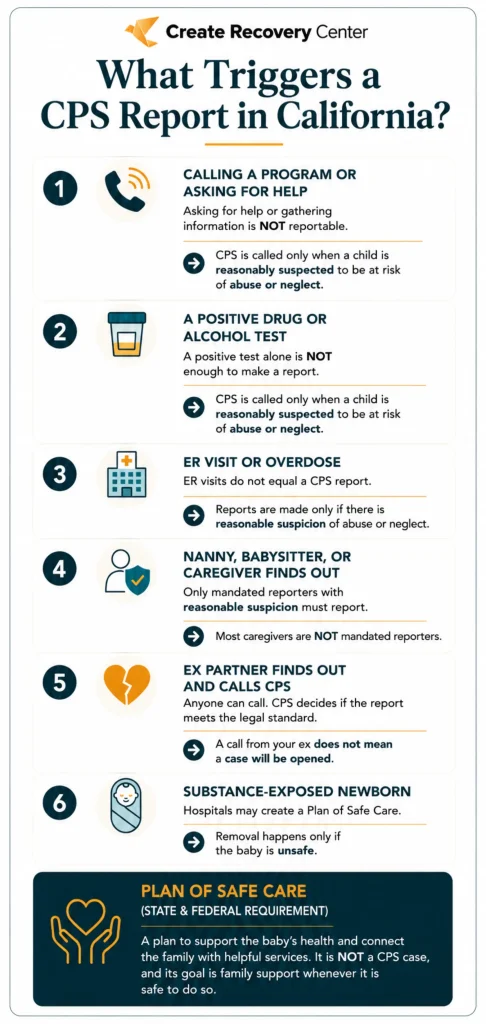
California’s Child Abuse and Neglect Reporting Act (CANRA) is the actual legal standard here, not internet folklore. CANRA lists more than 50 categories of professionals as mandated reporters, including doctors, nurses, and licensed alcohol and drug counselors. A mandated reporter must contact the county’s Child Protective Services hotline when they have knowledge of, or a reasonable suspicion of, child abuse or neglect.
What CANRA does not do is treat “parent has a substance use disorder” or “parent is seeking treatment” as an automatic trigger. A report under CANRA typically requires an observed or credible risk to a specific child, not a diagnosis or a treatment episode. Examples that do prompt a report include:
- A child left without adequate supervision because of a parent’s impairment
- Evidence a child was directly harmed or endangered by a parent’s substance use
- General neglect: a pattern where a child’s basic needs (food, hygiene, medical care, safety) go unmet
- A caseworker’s own observation of a home environment that is unsafe for a child
A parent calling a rehab for mothers, attending an appointment, or completing an intake assessment generally does not meet that bar on its own. The presence of general neglect, not the presence of addiction, is what CANRA is built to catch.
ER admission vs scheduled outpatient
A scheduled outpatient admission generally involves a different care setting from an emergency-room visit. You contact the program, complete an assessment, and begin treatment according to a planned schedule. The fact that you are entering outpatient treatment does not, by itself, create a CPS report.
An ER admission for an overdose, serious withdrawal complications, or a psychiatric emergency can involve a different set of circumstances. Healthcare professionals in emergency settings may need to assess immediate safety concerns, including whether a child is currently supervised and whether the parent’s medical condition has affected the child’s care. If a mandated reporter has knowledge of or reasonably suspects child abuse or neglect, a report may be required.
The important distinction is not simply outpatient versus ER. It is what the healthcare professional observes or reasonably suspects about the child’s safety in the circumstances. An ER visit does not automatically result in a CPS report, just as an outpatient admission does not guarantee that no report will ever be made.
For mothers comparing outpatient rehab Los Angeles options, a scheduled program may make it easier to plan around childcare, school, work, and other parenting responsibilities. Depending on the program’s schedule and your clinical needs, outpatient treatment may allow you to remain involved in school pickups, appointments, and other day-to-day responsibilities while receiving care.
But the appropriate level of treatment should always be based on your health and safety needs, not on avoiding a potential CPS report. If you are experiencing severe withdrawal symptoms, an overdose, or another medical emergency, seek the level of medical care appropriate for the situation rather than delaying emergency treatment because of concerns about CPS.
Who sees records: 42 CFR Part 2
Even when a report never happens, mothers want to know who can actually see that they’re in treatment. Substance use treatment records carry a separate, stronger layer of federal confidentiality than ordinary medical records: 42 CFR Part 2.
Part 2 generally restricts federally assisted substance use treatment programs from disclosing that a person is a patient, or sharing information identifiable as coming from the program, without written patient consent, except in narrow circumstances (such as a medical emergency, a court order meeting Part 2’s specific standard, or reporting required under state child abuse laws like CANRA). This is generally considered a higher bar than standard HIPAA protections. A treatment program is not permitted to casually hand your records to a family law attorney, a child’s other parent, or a school without your consent or a qualifying legal exception, even if they ask.
Whether treatment information appears in a custody proceeding depends on the circumstances, including consent, applicable Part 2 protections, and any legally valid process requiring or permitting disclosure. Every situation is different, so ask any program you’re considering how they handle Part 2 consent forms before you sign anything, and don’t sign a blanket release you don’t understand.
Childcare, work, school before day one
A lot of the anxiety around CPS involvement isn’t really about the law. It’s about logistics: who takes the kids to school, who’s home when they get off the bus, who calls in sick to work. Sorting these out before day one removes the single biggest actual risk factor, since an unclear childcare plan is closer to what CANRA’s general neglect standard is watching for than the fact of treatment itself.
Before you start:
- Line up a named, reliable adult for pickups, drop-offs, and overnight care, and put it in writing (a simple family safety plan, not a legal document, is enough for most outpatient timelines)
- Notify your child’s school or daycare only as much as you’re comfortable with; you are not obligated to disclose your treatment to school staff
- Talk to your employer about medical leave options (FMLA and California’s CFRA can both apply to treatment for a diagnosed condition)
- If your program works with a Plan of Safe Care, treat it as a planning tool, not a punishment; CAPTA (the federal Child Abuse Prevention and Treatment Act) directs states to develop these plans for substance-exposed infants and their families specifically to keep families together with support in place, not to open a case against you
- Ask your outpatient rehab for mothers whether their schedule offers evening or half-day tracks that fit around school pickup
An outpatient rehab for mothers built around a real parenting schedule, rather than a 9-to-5 clinic model, is often the difference between a plan that holds and one that falls apart in week two. Some moms find a women only rehab environment easier to open up in for exactly this reason: the group is made up of other parents navigating the same childcare and custody questions, not a mixed-gender general population.
Before deciding on a program, you can also review the admissions process and ask what information the program needs to begin treatment.
Ask a California family law attorney
Everything above describes how CANRA and Part 2 are supposed to work. Your specific situation — an open custody case, a prior CPS history, a co-parent who might use treatment against you — can change the calculus. That’s not a question a treatment program’s admissions team, however well-meaning, is qualified to answer.
If you have any active family court matter, or if a prior report exists in your file, talk to a California family law attorney before you enroll, not after. A short consultation can tell you exactly what disclosure risks exist in your case and how to structure your treatment (outpatient vs residential, timing, documentation) to protect both your recovery and your custody rights. Many attorneys offer this as a low-cost initial call specifically because the question comes up so often.
If you’re ready to talk through options confidentially before you decide anything, you can reach out for a confidential intake call and ask every question on this page directly.
Frequently Asked Questions
Will CPS be called if I go to rehab?
A positive newborn toxicology screen is more often the trigger for a Plan of Safe Care under CAPTA, which is a family support and monitoring plan, not a dependency case. A report is triggered by evidence of risk or neglect to a specific child, not by the act of seeking treatment.
Is a positive drug test a report?
Not on its own. A positive test with no other signs of risk to a child does not automatically meet CANRA’s reporting standard, though individual mandated reporters (such as hospital staff at delivery) may still report if they have independent concerns about the child’s safety. Substance-exposed infants are more commonly connected to a CAPTA-required Plan of Safe Care, which is a support plan, not a CPS case by default.
Will I lose custody if I go to rehab?
Seeking treatment is generally viewed as a protective factor rather than grounds for removal on its own. Custody concerns under WIC 300 typically arise from documented risk to a child’s safety, not simply from a parent being in treatment. That said, outcomes depend on the specifics of each case, so speak with a family law attorney about your situation.
Does my nanny, babysitter, or childcare provider have to report me?
Generally, only if they fall under a CANRA-mandated category (such as licensed daycare staff) and they personally observe or reasonably suspect neglect or risk to the child. A parent’s private decision to attend treatment, disclosed only to arrange coverage, is not typically, by itself, something a caregiver is required to report.
Can my co-parent or ex use my rehab enrollment against me in court?
Not directly from the treatment program itself. 42 CFR Part 2 restricts programs from disclosing that you’re a patient without your written consent, except in narrow situations like a valid court order. An ex would need another route (their own observations, a court subpoena meeting Part 2’s standard) to introduce it, and a documented treatment record often works in a parent’s favor rather than against it.
If my baby is born substance-exposed, does that automatically open a CPS case?
Not automatically. A positive newborn toxicology screen is more often the trigger for a Plan of Safe Care under CAPTA, which is a family support and monitoring plan, not a dependency case. A case under WIC 300 requires an additional finding of risk or neglect beyond the screen itself.