

If you’re taking Suboxone while pregnant, you have probably already heard a version of this warning from a friend, a relative, or a stranger in a comment section: taper off before the baby comes, or you’ll hand the baby withdrawal — and hand yourself a CPS case.
Almost none of that reflects what obstetric and addiction medicine organizations actually recommend. The professional guidance is close to the opposite: stay on your medication, tell your OB, and let the care team plan around it. This piece walks through what the evidence says, section by section, so you can separate clinical consensus from internet folklore.
This is general health information, not a substitute for care from your own OB or addiction medicine provider — your dose, your pregnancy, and your state’s specific reporting rules all shape what happens next, and those details belong in a conversation with your clinical team.
Telling Your OB Is Not a CPS Referral
One of the biggest reasons people hide medication for opioid use disorder (MOUD) from their prenatal care team is fear that disclosure alone triggers a child protective services (CPS) case. That fear is understandable, but it conflates two very different things: telling your doctor, and a hospital’s post-birth notification process.
Talking to your OB about buprenorphine — brand name Suboxone, or the buprenorphine monoproduct without naloxone — is a medical conversation, not a legal event. Nothing about disclosing a prescribed, medically supervised treatment during a prenatal visit automatically opens a child welfare file. Your OB needs to know because it changes how they monitor you, dose you, and plan your delivery. Withholding it removes their ability to do that safely.
Where the confusion comes from is a federal law called the Child Abuse Prevention and Treatment Act (CAPTA). CAPTA requires states receiving federal funding to have a process for identifying infants affected by prenatal substance exposure and connecting their families to a Plan of Safe Care. CAPTA requires states receiving federal funding to have policies and procedures for infants identified as being affected by substance exposure and for developing Plans of Safe Care. However, how these requirements are interpreted and implemented can vary by state, and the presence of prescribed medication-assisted treatment should not automatically be presented as evidence that a parent is unsafe or that removal will occur. Your OB, hospital social worker, or patient advocate can explain what notification and Plan of Safe Care requirements apply in your state and hospital.
The practical rules for what happens after delivery — who gets notified, how, and what a “substance-affected” newborn means — vary by state, and some states apply broader reporting standards than the federal floor. That variation is real, and it’s worth asking your OB or a hospital social worker directly what your state and your specific hospital do, before you’re in labor and trying to process it for the first time. But the starting point — the thing that should shape your decision about whether to tell your OB in the first place — is that disclosure and treatment compliance are what protect you and the baby, and hiding a prescribed medication removes your care team’s ability to manage your pregnancy well.
ACOG and SAMHSA Say Continue, Not Taper
The American College of Obstetricians and Gynecologists addressed this directly in ACOG Committee Opinion 711, “Opioid Use and Opioid Use Disorder in Pregnancy.” The guidance recommends opioid agonist pharmacotherapy for pregnant women with opioid use disorder and identifies both methadone and buprenorphine as established treatment options. This means that treatment such as methadone while pregnant or buprenorphine during pregnancy should be managed as part of coordinated prenatal and addiction care, rather than stopped simply because pregnancy has occurred. ACOG also favors a coordinated, multidisciplinary approach over criminal sanctions or punitive responses, framing pregnancy as an opportunity to engage someone in treatment rather than a reason to withdraw it.
The Substance Abuse and Mental Health Services Administration’s TIP 63, its clinical guidance on medications for opioid use disorder, is consistent with ACOG in supporting medication treatment for opioid use disorder during pregnancy. Both buprenorphine and methadone are established treatment options, and treatment should be individualized based on the patient’s clinical needs, treatment history, and response. ACOG recommends opioid agonist pharmacotherapy during pregnancy rather than medically supervised withdrawal because withdrawal is associated with high relapse rates and poorer outcomes.
This is where “what people tell you” Tends to diverge sharply from the clinical literature. Well-meaning friends and family, and sometimes providers unfamiliar with current addiction medicine guidance, still suggest tapering off buprenorphine before delivery so the baby is “clean” at birth. ACOG and SAMHSA do not support that framing, and the next section explains the physiological reason why. If you’re deciding whether to stay on Suboxone while pregnant based on what someone told you rather than what your prescriber recommends, this is the guidance to bring to that conversation.
Buprenorphine during pregnancy is sometimes prescribed as the monoproduct (buprenorphine alone) rather than the buprenorphine-naloxone combination in Suboxone, largely due to historical caution about naloxone exposure, though more recent data have supported the combination product as an option as well. Which formulation is right for you is a conversation for your prescriber, not something to decide from a comment thread.
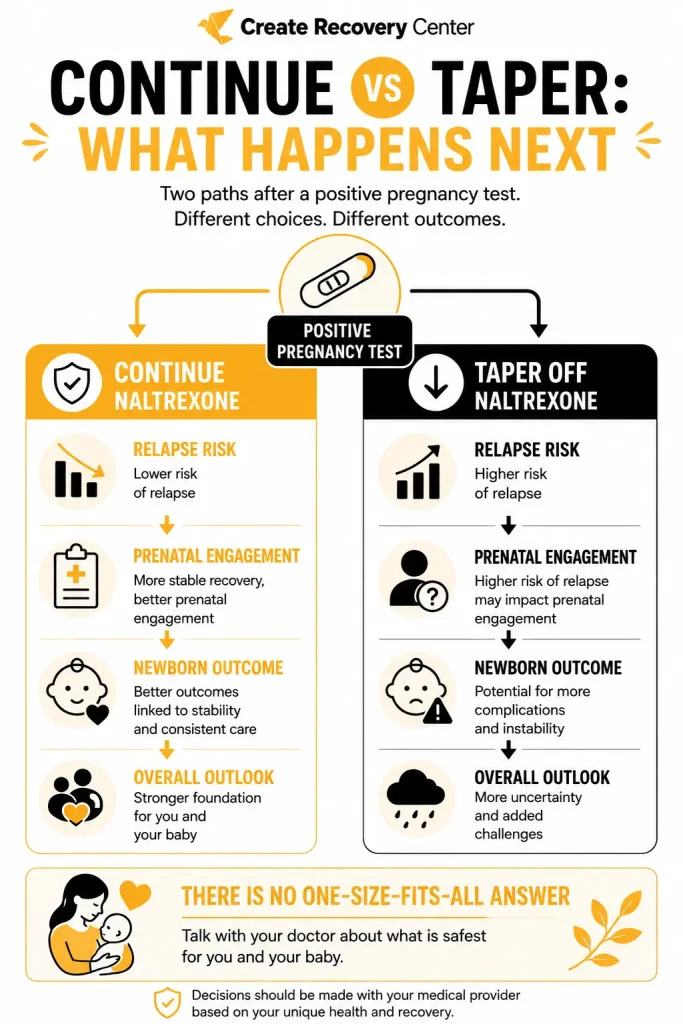
Why Withdrawal Raises Relapse and Fetal Risk?
The instinct to taper comes from a reasonable-sounding but incomplete idea: less medication in the mother’s system should mean less exposure for the baby. What that reasoning leaves out is what withdrawal itself does — to the pregnancy, and to the odds of staying in treatment at all.
Opioid withdrawal during pregnancy isn’t just uncomfortable for the mother. It has been associated with uterine irritability, and in some cases, contractions and preterm labor risk. A fetus doesn’t experience withdrawal in isolation from the mother’s physiology — maternal withdrawal is a stressor on the pregnancy itself, not a clean, contained event.
The bigger risk, though, is behavioral rather than pharmacological. Medically supervised taper attempts in pregnancy have high relapse rates. Someone who tapers off buprenorphine and then returns to illicit opioid use — heroin, diverted pills, fentanyl-contaminated supply — trades a stable, prescribed, monitored medication for an unpredictable one. Illicit opioid use carries overdose risk, exposure to unknown adulterants, and the boom-and-bust withdrawal cycles that come with inconsistent access, all of which are worse for a fetus than steady-state exposure to a prescribed medication. This is the core logic behind ACOG’s and SAMHSA’s continue-don’t-taper position: the comparison that matters isn’t “medication vs. nothing,” it’s “stable, monitored treatment vs. relapse risk and unregulated opioid exposure.”
Third-Trimester Dosing and Splitting
Buprenorphine’s pharmacokinetics change over the course of pregnancy. As blood volume increases and metabolism speeds up — particularly in the third trimester — some patients find their existing dose no longer holds them comfortably for a full 24 hours, and they start to feel early withdrawal symptoms before their next dose is due.
This is a known, well-documented phenomenon, not a sign that something has gone wrong. The clinical response is usually one of two adjustments: increasing the total daily dose, or splitting the same or a slightly higher total dose into two or three smaller doses spread across the day instead of one. Splitting the dose can smooth out blood levels and reduce the peaks and troughs that come with once-daily dosing, which some patients find more comfortable as pregnancy progresses.
Neither adjustment is a red flag, and neither should be read as “needing more drugs” in a stigmatizing sense — it’s the same kind of dose-adjustment conversation that happens with plenty of other pregnancy-affected medications. What matters is having a prescriber who is actively managing this with you rather than leaving your dose static and hoping it holds, or worse, treating a request for a dose adjustment as a sign of misuse. If you’re feeling withdrawal symptoms before your next dose in the third trimester, that’s worth bringing to your prescriber directly.
NOWS Is Treatable, Not Proof of Harm
Neonatal opioid withdrawal syndrome (NOWS) — sometimes still referred to by the older, broader term neonatal abstinence syndrome (NAS) — is the set of withdrawal symptoms a newborn can experience after birth if they were exposed to opioids, including prescribed buprenorphine or methadone, in utero. It’s real, it’s expected in a meaningful share of babies exposed to opioid agonist therapy, and it is not evidence that the mother’s treatment caused harm.
NOWS is a predictable, physiological consequence of the same mechanism that makes methadone and buprenorphine effective — sustained opioid receptor activity — carrying over briefly to a newborn whose exposure stops at birth. It’s treatable, it’s temporary, and hospitals that care for these newborns regularly do so without incident using structured, non-pharmacologic-first protocols.
Two tools show up often in NOWS management. The Finnegan score, developed decades ago, is a symptom-scoring tool that assigns points to signs like tremors, poor feeding, and excessive crying to help staff track severity and decide whether medication treatment for the infant is needed. More recently, many hospitals have moved toward or alongside an approach called Eat, Sleep, Console — which assesses a newborn more functionally, asking whether the baby can eat adequately, sleep for reasonable stretches, and be consoled, rather than tallying a symptom checklist. Eat, Sleep, Console has been associated in multiple studies with less use of pharmacologic treatment for NOWS and shorter hospital stays, largely by centering non-drug comfort measures and parental involvement as the first response.
That parental involvement point matters and connects to a broader trend: rooming-in, where the newborn stays with the parent rather than being moved to a NICU or separate nursery by default, is now widely supported as part of NOWS care. Skin-to-skin contact, breastfeeding or chestfeeding where appropriate, a low-stimulation environment, and a parent who can respond quickly to the baby’s cues are themselves treatment — not just comfort measures layered on top of medical care.
None of this means NOWS is nothing. It can mean a longer hospital stay, a baby who is harder to settle for a period of days, and real stress for new parents on top of everything else postpartum recovery brings. But it is a known, managed, time-limited condition — not a diagnosis of harm, and not a mark against the mother’s treatment choice. Babies exposed to methadone while pregnant or to Suboxone while pregnant are monitored for NOWS as standard practice, the same way any newborn with a known prenatal exposure would be.
Plan of Safe Care Is Care, Not Removal
A Plan of Safe Care is the document CAPTA requires states to have in place for infants identified as substance-affected. It’s easy to hear “plan” and “safe care” and assume it’s a euphemism for a removal proceeding. In its intended design, it isn’t.
A Plan of Safe Care is meant to be a coordinated support plan: connecting the family to pediatric follow-up, outpatient addiction treatment, home visiting programs, lactation support, housing or transportation assistance if needed, and a named point of contact. It’s built around the idea that a family in recovery, with a baby who may have NOWS, benefits from wraparound support in the weeks after discharge — not that the family is presumed unsafe.
That said, this is exactly the area where legal specifics genuinely vary by state, hospital, and individual case circumstances, and where general information reaches its limit. Some states treat a Plan of Safe Care as a purely voluntary, service-connection process; others fold it into broader child welfare notification systems with more oversight attached. Whether a report to child welfare happens at all, what it triggers, and how a Plan of Safe Care is administered in your hospital are questions with real, state-specific answers — and they’re best asked directly of your OB, a hospital social worker, or a patient advocate before delivery, so you know what to expect rather than encountering the process for the first time in a postpartum room.
Where to Go from Here?
The throughline across ACOG, SAMHSA, and current addiction medicine practice is consistent: staying on medication assisted treatment through pregnancy, disclosing it to your OB, and planning ahead for delivery and newborn care is the evidence-based path — not something to hide or unwind on your own. Suboxone while pregnant, when medically supervised, is treatment working as intended, not a problem to solve before the baby arrives.
If you’re weighing your options for structured outpatient support during or after pregnancy, an intensive outpatient program can provide the kind of coordinated counseling and monitoring that pairs well with ongoing MOUD. And if you have questions about starting or continuing treatment, our admissions team can walk through what that looks like for your situation.
For more on related topics, see the rest of our pregnancy and substance use series.