

If you take prescribed Suboxone and are facing a custody dispute, it is understandable to worry about how your treatment will be viewed. You may wonder whether a medication list, treatment record, or positive medication screen could be misunderstood as evidence that you are unable to safely parent.
The important distinction is between prescribed treatment for opioid use disorder (OUD) and untreated or uncontrolled substance use. Buprenorphine, the active opioid medication in Suboxone, is an established medication for OUD. Methadone is another established medication treatment.
Documentation can help provide context. Instead of leaving a court, attorney, evaluator, or other decision-maker to interpret a medication name by itself, organized records can show that treatment is prescribed, monitored, and part of an ongoing recovery plan.
This article focuses on documentation and general California considerations. Custody decisions are highly fact-specific, and laws and procedures can change. A California family law attorney should review your individual circumstances before you submit treatment records or make legal arguments.
For more information about parenting, recovery, treatment, and family support, explore our motherhood and recovery resources.
Buprenorphine Is Not Evidence of Unfitness?
Taking prescribed buprenorphine does not, by itself, establish that a parent is unfit.
Suboxone contains buprenorphine and naloxone and is commonly prescribed as part of OUD treatment. When used as directed under medical supervision, it is treatment—not the same thing as using illicit opioids.
The Americans with Disabilities Act (ADA) can provide important protections related to OUD. Questions about ADA protection for MAT can arise when prescribed medication for OUD is misunderstood as ongoing illicit drug use. The U.S. Department of Justice explains that people with OUD may be protected by the ADA when they meet applicable requirements, including people receiving medication treatment for OUD. The ADA’s application depends on the facts, the entity involved, and the specific legal issue.
That protection should not be overstated in a custody case.
The ADA does not mean that a family court must automatically award custody to someone taking medication for OUD. California custody decisions focus on the child’s best interests, and California Courts identify factors that can include each parent’s ability to care for the child and any regular and ongoing substance abuse.
The key issue is therefore context.
Your documentation can help establish:
- The medication is prescribed by a licensed healthcare professional.
- You are following the prescribed treatment plan.
- You attend scheduled appointments.
- Your provider monitors your treatment.
- You participate in recommended counseling or recovery services when applicable.
- You are working toward stability and continued recovery.
- There is no evidence of misuse when your records support that conclusion.
When medication assisted treatment is prescribed and monitored as part of OUD care, the treatment record can help explain why the medication is being used and how it fits into the patient’s overall recovery plan.
The same principle can apply to methadone. Methadone is also used to treat OUD, and taking it through an appropriate treatment program does not automatically establish that someone cannot safely parent.
If you are also pregnant or recently gave birth, you may have searched for information about Suboxone while pregnant. Pregnancy can add another layer of concern, but prescribed medication treatment should not automatically be characterized as evidence of parental unfitness. Medication decisions during pregnancy should be handled with the appropriate medical team.
What CANRA and CARA Require and Do Not?
Two legal frameworks may come up when substance use, pregnancy, newborns, or child welfare are involved: California’s Child Abuse and Neglect Reporting Act (CANRA) and the federal Comprehensive Addiction and Recovery Act of 2016 (CARA), which amended provisions of the Child Abuse Prevention and Treatment Act (CAPTA).
They address different issues, and neither should be reduced to the idea that “taking Suboxone means CPS will take your child.”
CANRA
CANRA establishes California’s framework for mandated reporting of suspected child abuse and neglect.
California law defines neglect in terms of negligent treatment or maltreatment under circumstances indicating harm or threatened harm to a child’s health or welfare.
California law also addresses situations involving a newborn’s positive toxicology screen. A positive toxicology screen at delivery, by itself, is not sufficient grounds for a child abuse or neglect report under the applicable provision; the law also addresses assessment of the needs of the mother and child and other circumstances indicating risk.
That distinction matters.
A prescribed medication appearing on a medical record should not automatically be equated with illegal drug use or parental neglect. At the same time, treatment records do not guarantee that a custody or child welfare issue will never arise. Other facts involving the child’s safety and the parent’s ability to provide care can still matter.
CARA 2016 and Plans of Safe Care
CARA 2016 amended CAPTA provisions governing infants affected by prenatal substance exposure or withdrawal and expanded federal requirements related to Plans of Safe Care.
A Plan of Safe Care is intended to address the health and safety needs of an affected infant and the treatment or support needs of the family or caregiver. Federal guidance describes these plans as a mechanism for coordinating services rather than simply treating substance exposure as a stand-alone finding of parental unfitness.
State implementation matters, so the exact process can differ.
The important takeaway is that CARA does not create a simple rule that prescribed medication equals parental unfitness.
It is also important not to confuse a Plan of Safe Care with an automatic custody order. A family may be connected with services or assessments without that alone determining the final outcome of a custody proceeding.
Because these laws are technical and fact-specific, an attorney should review how CANRA, CARA, and any applicable California dependency or family-law procedures apply to your circumstances.
Records to Keep From Day One
If you are concerned about how your treatment may be viewed during a custody dispute, start organizing documentation early.
You do not need to create a massive file containing every medical record you have ever received. The goal is to maintain relevant, accurate documentation that demonstrates continuity of care.
Consider keeping copies of:
Prescription Records
Keep documentation showing:
- Medication name
- Prescribed dosage
- Prescribing clinician
- Date prescribed
- Pharmacy information
- Refill history when available
For Suboxone, records should identify the prescribed medication clearly rather than leaving a reviewer to guess why buprenorphine appears in your records.
Treatment Attendance
If you participate in an OUD treatment program, keep records showing attendance and participation.
This might include:
- Medication management appointments
- Counseling sessions
- Recovery support appointments
- Program completion documentation
- Treatment-plan reviews
- Appointment summaries
Consistent participation can help establish that treatment is ongoing rather than something you started only after a custody dispute began.
Observed Drug Screens
When clinically and legally appropriate, an observed drug screen may provide additional documentation of treatment adherence.
Do not assume that every drug test is automatically favorable evidence. A laboratory result can require context, particularly when prescribed medications or metabolites appear on the panel.
Ask your provider or attorney how a specific result should be interpreted before submitting it.
Provider Notes
Treatment notes can document the clinical reasoning behind your medication and ongoing care.
However, do not automatically provide your entire behavioral-health or substance-use record to the opposing party. Some records may contain highly sensitive information that is not necessary to establish treatment compliance.
Ask your attorney what documentation is actually relevant.
Recovery and Support Documentation
Depending on your treatment plan, you may also keep records of:
- Family therapy
- Individual counseling
- Parenting education
- Recovery meetings
- Outpatient treatment
- Case-management services
- Other recommended support services
If family relationships have been affected by addiction or custody stress, family therapy may provide another form of support.
Keep a Timeline
A simple timeline can be especially useful.
For example:
January: Began treatment with prescribed buprenorphine.
February: Attended scheduled medication-management appointments.
March: Completed recommended counseling sessions.
April: Prescriber reviewed treatment plan and continued medication.
A timeline can help your attorney quickly understand the progression of your care without having to sort through hundreds of pages.
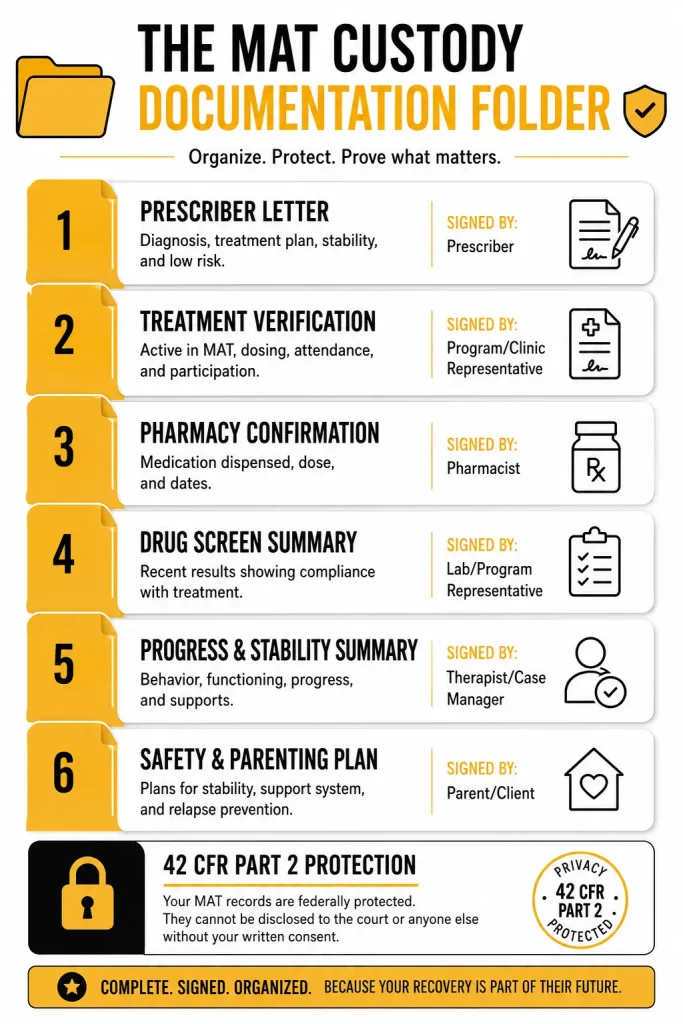
What a Prescriber Letter Must State?
A prescriber attestation can be useful when a custody dispute involves questions about why you take buprenorphine. There is no single required format for every custody case, but a useful prescriber attestation may address the following points when they are clinically accurate and appropriate to disclose.
The exact content should be determined by the clinician and your attorney. The goal is to provide clinically accurate information—not to create a statement designed to guarantee a particular custody outcome.
A useful letter may address:
1. The Medication
The provider can identify that you are prescribed buprenorphine, including the formulation and current prescribed dose when clinically appropriate.
2. The Treatment Purpose
The provider can explain that the medication is being used as part of treatment for OUD.
3. Medical Supervision
The letter can confirm that the medication is prescribed and monitored by the clinician.
4. Treatment Participation
When supported by the provider’s records, the letter can describe your participation in appointments and adherence to the treatment plan.
5. Clinical Observations
The provider may be able to describe relevant clinical observations, such as stability in treatment or progress toward treatment goals, provided those statements are accurate and appropriate to disclose.
6. Relevant Parenting Considerations
If the provider has enough information to address them appropriately, they may discuss whether the prescribed treatment itself is expected to interfere with functioning or the ability to follow the treatment plan.
The provider should avoid making legal conclusions such as “the court must give this parent custody.” A medical professional’s role is to provide accurate clinical information; the court and attorneys handle legal conclusions.
Likewise, do not ask a provider to make statements they cannot independently support.
How MAT Gets Mischaracterized, and Answered?
One of the biggest problems in a custody dispute can be reducing a complicated treatment history to a single word.
For example:
Mischaracterization:
“She is taking an opioid, so she is still using drugs.”
Context:
Buprenorphine is an established medication used to treat OUD. The relevant records may show that it is prescribed and taken under medical supervision.
The DOJ explains that people receiving medication treatment for OUD may be protected under the ADA when applicable requirements are met.
Another example:
Mischaracterization:
“She went to rehab, so she must have been incapable of parenting.”
Context:
Seeking treatment can also demonstrate that a person recognized a health problem and took steps to address it. Whether treatment participation affects custody depends on the facts and the child’s best interests.
If you have ever wondered, “will I lose custody if I go to rehab?”, there is no universal answer. Going to treatment does not itself determine a custody outcome. California custody decisions are individualized, and courts consider the child’s best interests along with relevant circumstances.
A third example:
Mischaracterization:
“MAT means the parent is dependent on drugs.”
Context:
Physical dependence and addiction are not interchangeable concepts. Some medications can produce physical dependence while being used appropriately as part of medical treatment. The important question is what the medication is prescribed for, whether it is being used as directed, and what the clinical record shows.
What About a Positive Drug Screen?
A positive result for a medication can be misunderstood if the person reviewing it does not know what was prescribed.
This is why medication lists, prescriptions, pharmacy records, and provider documentation should be considered together.
If a screen is positive for buprenorphine and you have a current prescription, your attorney can help determine how that result should be presented in context.
The same principle applies to methadone.
Do not alter, hide, or manipulate medical records to make them appear more favorable. Preserve the original documentation and allow your attorney to determine which records should be provided and how they should be explained.
Understanding 42 CFR Part 2 Court Orders
Another issue can arise when someone requests records from an addiction treatment provider.
Certain substance use disorder treatment records receive special federal confidentiality protections under 42 CFR Part 2. Whether Part 2 applies, and what disclosure process is required, can depend on the program, the records involved, consent, and the type of proceeding.
Part 2 can apply to records maintained by covered SUD treatment programs, and its rules are different from ordinary medical-record disclosure rules.
A subpoena or general request for records does not necessarily mean that a Part 2 program can simply release protected records. For noncriminal proceedings, federal regulations provide a court-order process with specific requirements and safeguards. The order may need to limit disclosure to information that is essential to the purpose of the proceeding and to the people whose need for the information supports disclosure.
The rules have also been updated, so older articles about Part 2 may not accurately describe the current requirements.
If your treatment provider tells you that a 42 CFR Part 2 court order is required, do not assume that the provider is refusing to cooperate. The provider may be required to follow federal confidentiality rules.
Your attorney can determine whether you should provide consent, object to a request, seek a protective order, or take another legal step.
Have a CA Family Law Attorney Review
If you are facing an actual custody battle, documentation is only one part of the process.
A California family law attorney can help determine:
- Which records are relevant
- Which records should not be disclosed unnecessarily
- Whether a subpoena is legally sufficient
- Whether 42 CFR Part 2 applies
- How to respond to requests for treatment records
- How prescribed buprenorphine should be presented
- Whether additional evidence of parenting stability would be useful
- How California’s custody standards apply to your circumstances
California Courts explain that custody decisions concern the child’s best interests and can involve factors such as the child’s health, emotional ties, each parent’s ability to care for the child, family violence history, and regular and ongoing substance abuse.
That means a custody dispute should not be reduced to the question, “Does this parent take Suboxone?”
Instead, medication assisted treatment should be considered in the broader context of the parent’s treatment history, current stability, adherence to care, and ability to meet the child’s needs.
Your attorney may recommend presenting treatment documentation alongside evidence of stable housing, employment, parenting involvement, counseling, visitation compliance, medical care, or other relevant facts.
The strongest documentation is usually accurate, consistent, and independently verifiable.
Building a Treatment Record That Tells the Full Story
If you are currently receiving medication assisted treatment, you do not need to wait for a custody dispute to begin organizing your records.
Start with a simple folder—digital or physical—and keep relevant documents together.
A practical documentation checklist may include:
- Current medication list
- Prescription records
- Pharmacy records
- Treatment attendance
- Provider appointment summaries
- Appropriate drug-screen results
- Treatment-plan updates
- Counseling or family therapy attendance
- Recovery-support documentation
- Provider letters or attestations
- Relevant parenting-program certificates
- Copies of legal requests for treatment records
- Communications concerning subpoenas or court orders
Avoid collecting documents simply for volume. More records do not necessarily make a stronger case.
The objective is to create a clear, accurate picture of your treatment and functioning.
If you are considering treatment but are worried that entering care could affect your family, that concern is worth discussing with both a qualified attorney and a treatment professional. Treatment decisions should be based on health and safety needs rather than fear of how a medication name might appear on paper.
For information about available treatment options, you can review addiction treatment programs or the admissions process.
The Bottom Line
Prescribed medication assisted treatment is healthcare. A custody dispute may still require careful documentation, but the presence of buprenorphine or methadone on a medication list does not, by itself, answer the broader question of whether a parent can safely care for a child.
If you take Suboxone, keep accurate records showing the prescription, treatment participation, monitoring, and other relevant aspects of your recovery.
If you receive a request for confidential treatment records, understand that 42 CFR Part 2 may impose additional confidentiality requirements. A qualifying court order may be required for certain disclosures, and the rules can be technical.
If you are pregnant and taking buprenorphine, concerns about Suboxone while pregnant should be discussed with your healthcare providers rather than prompting an unsupervised medication change.
And if you are worried that seeking treatment will automatically cost you custody, remember that the answer depends on the facts of your case. California custody decisions are based on the child’s best interests, not simply the existence of a treatment medication.
Most importantly, do not try to build a legal strategy by hiding treatment, altering records, or stopping prescribed medication without medical guidance.
Keep your documentation accurate. Let your prescriber provide clinical facts. Let your attorney handle the legal strategy.