

If you are breastfeeding and wondering whether one drink means you need to stop nursing, wait all night, or pump and dump, the answer is more nuanced than most social-media advice makes it sound.
Alcohol does enter breast milk, but it does not become permanently trapped there. The amount in milk generally follows the alcohol concentration in the mother’s blood and decreases as alcohol leaves the bloodstream.
At the same time, breastfeeding does not make heavy or frequent alcohol use harmless. The amount consumed, timing, your baby’s age and health, and your ability to safely care for your baby all matter.
That is why drinking while breastfeeding is best understood through actual alcohol physiology rather than folklore.
If alcohol has become something you use to manage stress, anxiety, sleep problems, or postpartum depression, there is another issue to consider. Postpartum depression and alcohol can reinforce each other, and drinking may sometimes become part of a pattern rather than an isolated choice.
The goal is not to shame you for drinking. It is to give you enough information to make safer decisions and recognize when you may need additional support.
One Drink Does Not Make You Unsafe or Reportable
A common fear among new mothers is that admitting to having a drink while breastfeeding automatically makes them a bad parent or puts them on a CPS list.
It does not work that way.
Alcohol consumption and child neglect are not automatically synonymous. In California, the Child Abuse and Neglect Reporting Act (CANRA) requires a mandated reporter to make a report when, in a professional capacity or within the scope of employment, the reporter knows or reasonably suspects that a child has been the victim of abuse or neglect. The reporting threshold is based on the circumstances and reasonable suspicion, not simply on the fact that a mother had an alcoholic drink.
A single drink while breastfeeding is not, by itself, a legal determination of child abuse or neglect. Specific facts involving a child’s safety, supervision, or suspected abuse or neglect can change the reporting analysis.
However, context matters.
There is a significant difference between having an occasional drink and being intoxicated while responsible for an infant. A parent who is heavily intoxicated may have impaired judgment, coordination, reaction time, and ability to respond to a baby’s needs.
That means the safety question is bigger than breast milk alone.
If you have been drinking, consider whether another sober adult can take responsibility for the baby if you feel impaired. Never co-sleep with an infant while intoxicated, and never drive after drinking.
The CDC states that not drinking alcohol is the safest option while breastfeeding. It also notes that moderate consumption, meaning up to one standard drink in a day, is not known to be harmful to the infant. To be safest after a single drink, the CDC advises waiting at least two hours before nursing; higher alcohol intake can increase infant exposure and can impair a parent’s ability to care for the baby safely.
So if you had one drink and are now worried that you have permanently harmed your baby, try not to panic.
Instead, understand how alcohol moves through your body.
How Alcohol Enters and Leaves Milk
When you drink alcohol, it is absorbed into your bloodstream.
Your blood alcohol concentration (BAC) rises as alcohol enters your circulation and falls as your body metabolizes and eliminates it.
Alcohol can also enter breast milk.
The concentration in breast milk generally parallels the concentration in maternal blood. This is sometimes discussed using the milk-to-plasma ratio, which compares the concentration of a substance in milk with its concentration in plasma.
For alcohol, there is not a separate storage compartment in breast tissue where alcohol remains long after it has cleared from your bloodstream.
As your blood alcohol concentration falls, the amount of alcohol in your milk also falls.
This is why waiting for your body to metabolize the alcohol is what matters.
What Counts as a Standard Drink?
One reason breastfeeding advice becomes confusing is that people often underestimate how much alcohol they actually consume.
In the United States, a standard drink contains approximately:
- 12 ounces of regular beer at about 5% alcohol
- 5 ounces of wine at about 12% alcohol
- 1.5 ounces of distilled spirits at about 40% alcohol
A large restaurant pour or oversized wine glass can contain more than one standard drink.
For drinking while breastfeeding, counting standard drinks matters more than counting glasses because the amount of alcohol consumed affects how long you may need to wait before nursing.
That matters when estimating how long alcohol may remain in your bloodstream and breast milk.
For example, saying “I only had one glass of wine” does not necessarily tell you how much alcohol was consumed. A five-ounce serving and a nine-ounce pour are very different amounts.
If you want to estimate your intake more accurately, measure the serving rather than relying on the size of the glass.
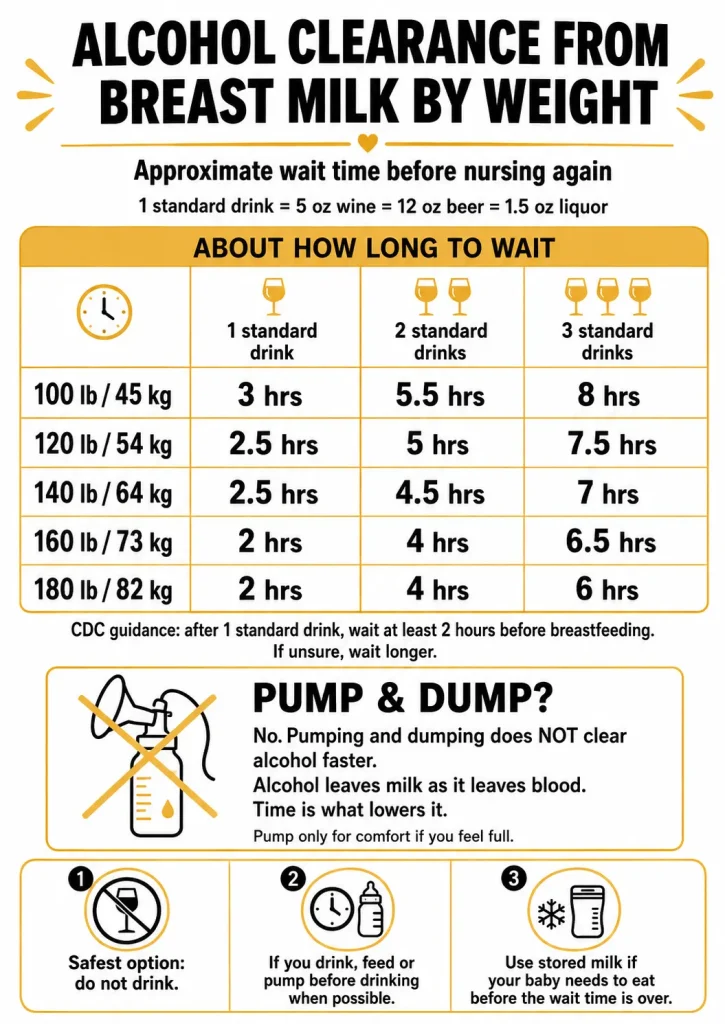
Body Weight and Clearance
Alcohol does not leave everyone’s body at exactly the same rate.
Body weight, food intake, how quickly you drank, medications, liver function, and other individual factors can affect BAC and alcohol clearance.
This is why a simple universal chart promising that “one drink is always gone in exactly X hours” can be misleading.
The NIAAA provides standard-drink definitions and information about alcohol metabolism, but individual clearance still varies.
For breastfeeding decisions, time since drinking is more useful than trying to make a precise calculation from weight alone.
The CDC advises waiting at least two hours after a single standard drink before breastfeeding. LactMed similarly advises about 2 to 2.5 hours per drink for casual alcohol use, while emphasizing that timing varies with the amount consumed and individual factors.
If you have consumed several drinks, do not assume that two hours per drink is an exact guarantee of zero alcohol exposure. The safest approach is to allow additional time and, if you are significantly impaired, have a sober adult care for the baby.
What About Letdown?
Alcohol can affect breastfeeding in ways beyond milk concentration.
Some research suggests alcohol may temporarily interfere with milk ejection or letdown, and mothers may notice changes in feeding behavior or milk production depending on the circumstances.
This is another reason frequent alcohol consumption can be different from an occasional drink.
If you notice persistent problems with milk supply, feeding, or letdown, talk with a lactation professional or healthcare provider rather than assuming alcohol is the only explanation.
Why Pump and Dump Speeds Up Nothing
“Pump and dump” is one of the most persistent pieces of breastfeeding folklore.
The idea is simple:
Drink → pump → throw away milk → alcohol disappears faster.
But that is not how alcohol metabolism works.
Pumping removes milk from the breast, but it does not remove alcohol from your bloodstream.
As long as alcohol remains in your blood, alcohol can continue to enter newly produced breast milk.
So pumping does not make your body clear alcohol faster.
You may still choose to pump for other reasons.
For example, if your breasts become uncomfortably full while you are waiting for alcohol to clear, pumping can provide physical relief. But the milk expressed while alcohol is present should not be considered alcohol-free simply because it was pumped.
As alcohol leaves your bloodstream, alcohol levels in breast milk fall as well. Once maternal blood alcohol has cleared, alcohol in breast milk falls accordingly.
That is the important distinction.
Can You Pump Before Drinking?
Yes.
Some breastfeeding mothers pump beforehand so they have milk available for the baby while they wait for alcohol to clear.
That can be especially useful if your baby is likely to need a feeding during the waiting period.
The purpose is not to remove alcohol from your body.
It is simply to have an alternative feeding option available.
If you regularly need to plan multiple feeds around alcohol consumption, however, it may be worth asking yourself why drinking has become such a significant part of your routine.
Timing a Drink Around a Feed
If you choose to drink while breastfeeding, timing can reduce the baby’s exposure.
The CDC recommends waiting at least two hours per standard drink before breastfeeding. Alcohol levels in breast milk are generally highest when maternal blood alcohol concentration is highest and then decline as the alcohol is metabolized.
One practical approach is to feed the baby immediately before having a drink.
For example:
Feed → drink → wait → resume breastfeeding when enough time has passed.
If your baby needs to feed during the waiting period, previously expressed breast milk or formula can be used if appropriate for your baby’s feeding plan.
Remember that the two-hour guideline is not a stopwatch that guarantees identical clearance for every person.
Several factors can affect how long alcohol remains in your bloodstream, including how much you drank and how quickly you consumed it.
More drinks require more time.
What If You Had More Than One Drink?
If you had two drinks, do not simply assume that you can breastfeed safely two hours later.
The CDC’s guidance is generally framed around waiting at least two hours per drink, but individual clearance varies.
If you are still feeling the effects of alcohol, assume that you may still have alcohol in your bloodstream.
And if you are intoxicated, the priority becomes infant safety—not simply breast milk timing.
Have a sober adult care for the baby, avoid driving, and avoid situations where impaired coordination or judgment could put your baby at risk.
What Does LactMed Say?
LactMed, the National Library of Medicine’s database on drugs and lactation, is another useful evidence-based resource for understanding medication and substance exposure through breast milk.
LactMed includes information about alcohol and breastfeeding as well as many medications that breastfeeding mothers may encounter.
Because recommendations can change as evidence develops, it is better to rely on current medical resources and your healthcare professional than on an old social-media post or a blanket rule shared in a parenting group.
When Occasional Becomes a Pattern
The question changes when alcohol is no longer occasional.
Maybe the original plan was one glass on Friday.
Then it became Friday and Saturday.
Then most evenings.
Then you started looking forward to the drink more than the evening itself.
That does not automatically mean you have an alcohol use disorder, but it is worth examining.
When drinking while breastfeeding shifts from an occasional choice to a frequent coping routine, looking at the overall pattern becomes more important than focusing only on the timing of a feed.
Ask yourself:
- How often am I drinking?
- How much am I actually consuming?
- Do I regularly drink more than I intended?
- Can I comfortably skip alcohol?
- Do I use alcohol to manage stress, anxiety, sadness, or sleep?
- Have I tried to cut down and struggled?
- Do I feel uncomfortable when I cannot drink?
- Has drinking affected breastfeeding, sleep, relationships, or parenting?
- Am I hiding or minimizing how much I drink?
NIAAA levels can provide additional context for a drinking pattern. For women, NIAAA defines heavy drinking as 4 or more drinks on any day or 8 or more drinks per week. These levels do not diagnose alcohol use disorder, but regularly reaching them can be a reason to discuss your alcohol use with a healthcare professional.
The AUDIT-C is a commonly used screening tool that asks about drinking frequency, quantity, and occasions involving heavier alcohol consumption.
A screening score does not diagnose alcohol use disorder, but it can provide a useful starting point for discussing your drinking with a healthcare professional.
When “Wine Mom” Stops Being a Joke
The phrase wine mom is often used casually to describe a mother who drinks wine as part of her evening routine.
There is nothing inherently diagnostic about the label.
But cultural normalization can make frequent drinking difficult to recognize.
If alcohol is consistently your reward for surviving the day, your way of handling difficult emotions, or something you feel you need before you can relax, the pattern deserves attention.
You do not have to wait until drinking causes an obvious crisis.
And you do not need to decide whether you are an “alcoholic” before talking to someone.
Look at the behavior instead of the label.
If alcohol has become difficult to control, professional support can help.
Help Without Leaving Your Baby’s Day
Many mothers assume that getting help for alcohol use means leaving their baby and entering residential treatment.
That is not always the case.
The appropriate level of care depends on your drinking pattern, withdrawal risk, medical needs, mental health, home environment, support system, and other factors.
For some women, outpatient treatment can provide support while they continue living at home.
An intensive outpatient program can offer structured therapy, education, counseling, relapse-prevention work, and other services without requiring residential placement in every case.
You can explore alcohol addiction treatment or learn more about virtual intensive outpatient treatment if remote care could make treatment easier to fit around parenting responsibilities.
How to Stop Drinking Safely
If you are thinking about how to stop drinking, the safest approach depends on how much and how frequently you currently drink.
Someone who drinks heavily every day may experience withdrawal after suddenly stopping. Alcohol withdrawal can become medically dangerous and may involve seizures or delirium.
Do not assume that quitting cold turkey is always the safest choice.
If you drink heavily or regularly, talk with a healthcare professional about whether you need medical supervision, a gradual treatment plan, medication, or another form of support.
If your drinking is occasional and you simply want to take a break, you may be able to make changes without medical detoxification.
Either way, asking for help is not a failure.
If you are unsure how to stop drinking safely, a healthcare professional can help you choose an approach based on your current use and withdrawal risk.
When Postpartum Mental Health Is Part of the Picture
Alcohol can sometimes become a way of managing the emotional demands of new motherhood.
You may be exhausted.
You may feel isolated.
You may be experiencing anxiety or depression.
You may be struggling with your identity after having a baby.
That can create a cycle in which alcohol provides temporary relief but contributes to disrupted sleep and worse mood afterward.
If you are experiencing persistent sadness, hopelessness, anxiety, loss of interest, or difficulty functioning, tell your healthcare provider.
And if alcohol is part of the coping pattern, mention that too.
Your clinician can help address both issues instead of treating them as unrelated problems.
When postpartum depression and alcohol are both part of the picture, discussing them together can help your clinician understand how mood, sleep, coping, and drinking may be affecting one another.
The Real Timeline Matters More Than the Folklore
There is no need to panic because you had one drink while breastfeeding.
There is also no reason to rely on myths such as “pump and dump gets alcohol out faster.”
The key facts are straightforward:
- Alcohol enters breast milk as it enters the bloodstream.
- Breast milk alcohol levels generally rise and fall with maternal blood alcohol concentration.
- Pumping does not speed alcohol metabolism.
- A standard drink is smaller than many restaurant or home pours.
- The CDC recommends waiting at least two hours per standard drink before breastfeeding.
- More alcohol generally means more waiting time.
- If you are impaired, infant-care safety becomes a priority.
- Frequent or difficult-to-control drinking deserves a conversation with a healthcare professional.
- Most importantly, drinking while breastfeeding does not need to become a source of shame.
If you had a drink and are worried, get accurate information.
If alcohol has become part of your daily routine, look at the pattern.
If you are struggling to stop, ask for help.
And if you are worried that seeking treatment will make you a worse mother, remember that getting support can be part of protecting your health and your ability to care for your baby.
Frequently Asked Questions
How long after drinking can I nurse?
After a single standard drink, CDC guidance recommends waiting at least two hours before breastfeeding. LactMed advises about 2 to 2.5 hours per drink for casual alcohol use. More drinks generally require more time, and individual clearance varies.
Does pumping and dumping work?
Pumping and dumping does not make alcohol leave your bloodstream or breast milk faster. Alcohol levels in breast milk fall as blood alcohol levels fall. Pumping can still be useful for comfort or to maintain your usual pumping schedule while you wait.