

Having a baby can be joyful and exhausting at the same time. Sleep may become fragmented, routines can disappear, and the pressure to feel happy can make difficult emotions even harder to admit.
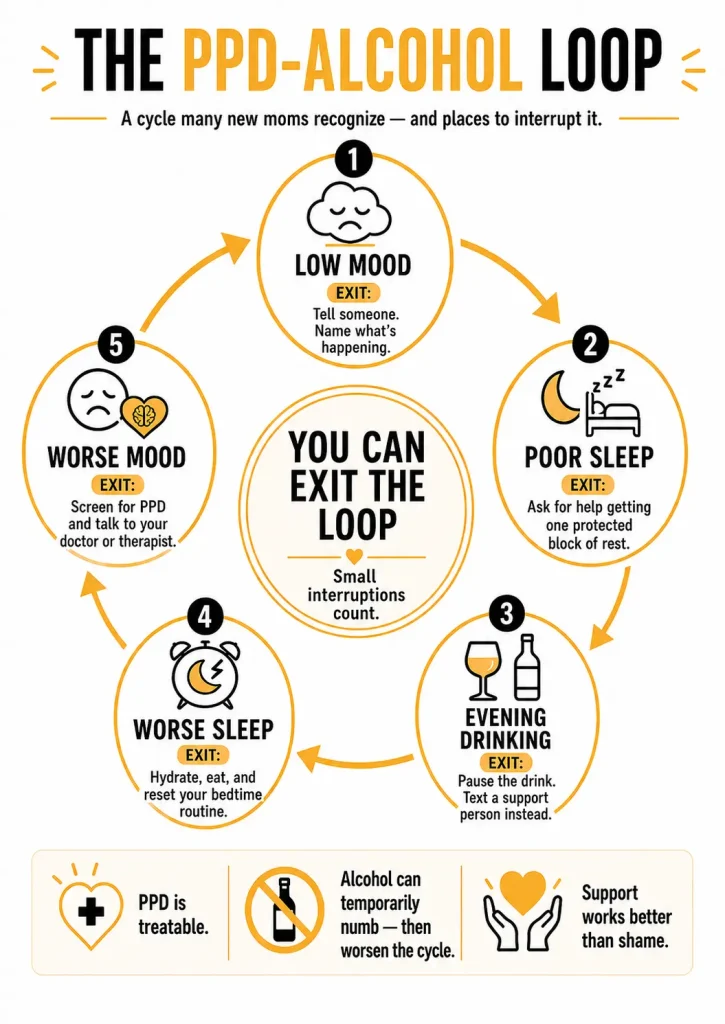
For some women, that combination can create a loop: low mood makes sleep and coping harder, alcohol becomes a way to switch off in the evening, alcohol disrupts sleep further, and the next day begins with even more exhaustion or distress.
What starts as temporary relief can gradually become part of the problem it was meant to solve.
That does not make you weak or irresponsible. Postpartum depression and alcohol can overlap in complicated ways, and recognizing the pattern is a reason to seek support—not a reason to feel ashamed.
Postpartum depression (PPD) is a medical condition that can occur after childbirth. Symptoms can include persistent sadness, anxiety, hopelessness, irritability, loss of interest, difficulty functioning, or feeling disconnected from your baby. It can be treated with psychotherapy, medication, or a combination of approaches depending on the individual.
If drinking has become part of how you manage postpartum distress, you do not necessarily have to choose between addressing your mental health and addressing your alcohol use. Both concerns can be discussed with your healthcare team, and support can enter at more than one point in the cycle.
A PPD Diagnosis Is Not a CPS Watch List
One of the biggest fears some new mothers have is that admitting they are depressed will automatically lead to child protective services (CPS) involvement.
A diagnosis of postpartum depression is not automatically a child abuse or neglect finding, and it does not by itself place a parent on a CPS watch list.
In California, the Child Abuse and Neglect Reporting Act (CANRA) establishes duties for mandated reporters when they know or reasonably suspect child abuse or neglect. The law does not treat postpartum depression, by itself, as child abuse or neglect. Reporting depends on whether the facts of a specific situation meet the legal standard for suspected abuse or neglect, including concerns about harm or threatened harm to a child’s health or welfare.
That distinction matters.
Being depressed is not the same as being unable or unwilling to provide basic care or placing a child at substantial risk. A person can experience significant depression and still be a loving, attentive parent who is seeking treatment.
At the same time, mental health professionals have responsibilities when there are specific safety concerns. Under California law, a mandated report is required when the applicable legal standard for suspected child abuse or neglect is met. The diagnosis alone is not the trigger; the surrounding facts and child-safety concerns matter.
So the more accurate way to think about the issue is:
PPD diagnosis ≠ automatic CPS report.
A diagnosis is a starting point for assessment and treatment.
The same principle applies to alcohol use. Telling a doctor that you have been drinking to cope with depression does not automatically mean CPS will become involved or that you will lose your baby. What happens next depends on the circumstances, including the severity of alcohol use, whether the child is safe, whether appropriate supervision is available, and whether other risk factors raise a reasonable concern for abuse or neglect.
If fear of CPS is keeping you from telling your doctor that you are depressed or drinking more than you intended, tell your provider about that fear. You can ask what information is confidential, what situations require reporting, and what support is available.
Getting help early can be part of protecting both your health and your ability to care for your baby.
How PPD and Drinking Reinforce Each Other?
The cycle can sometimes look like this:
Low mood → poor sleep → evening drinking → worse sleep → worse mood.
Then the cycle repeats.
Postpartum depression can make ordinary tasks feel overwhelming. You may feel sad, numb, anxious, irritable, disconnected from your baby, or unable to enjoy things that used to matter to you.
Sleep deprivation can make everything harder.
When the baby finally goes to sleep, alcohol may seem like a quick way to relax. The first drink may feel calming. The problem is that alcohol can interfere with sleep quality, even when it initially makes you feel sleepy.
The next day can then bring more exhaustion, irritability, anxiety, or low mood.
This is one reason postpartum depression and alcohol can become difficult to separate in everyday life. What begins as an attempt to cope with one problem can gradually make the other harder to manage.
That can create another reason to drink.
Research has identified an association between postpartum depressive symptoms and substance use, although the relationship is complex and does not mean alcohol causes postpartum depression in every individual.
The relationship between alcohol and depression can also work in more than one direction. Someone experiencing depression may drink to cope, while problematic drinking can contribute to mood problems and make recovery from depression more difficult.
That is why treating only one side of the cycle may leave the other side untouched.
When Drinking Becomes Part of the Routine?
The phrase wine mom is often presented as a joke about motherhood.
A glass of wine after putting the kids to bed can be portrayed as a harmless reward for surviving the day.
For some women, it is exactly that: an occasional drink with no meaningful consequences.
For others, the cultural normalization can make it harder to notice when drinking has changed.
You might start asking:
- Do I look forward to drinking more than I look forward to anything else?
- Do I drink mainly when I feel overwhelmed or depressed?
- Have I started drinking alone or hiding how much I drink?
- Do I need more alcohol to get the same calming effect?
- Do I feel worse the next morning but still repeat the pattern?
- Have I tried to cut back and found it harder than expected?
There is no single answer that diagnoses an alcohol problem.
But these questions can help identify a pattern worth discussing with a healthcare professional.
The EPDS Screen at Six Weeks
You may hear about the EPDS, or Edinburgh Postnatal Depression Scale, during postpartum care.
The EPDS is a 10-question screening tool used to identify symptoms that may indicate postpartum depression. It is one of several validated screening instruments used during the perinatal period.
But there is an important misconception about timing.
You do not have to wait until the traditional six-week postpartum visit to mention depression.
ACOG recommends screening for perinatal mental health conditions at multiple points and emphasizes a comprehensive postpartum assessment no later than 12 weeks after birth. Additional screening may also occur during pediatric visits in the first postpartum year.
So if you are six weeks postpartum and struggling, the EPDS can be useful—but you should not wait for the screening appointment if you already know something feels wrong.
Likewise, a screening score is not the same thing as a diagnosis.
A clinician considers the screening result alongside your symptoms, history, functioning, safety, and other factors.
If your symptoms include persistent sadness, loss of interest, intense anxiety, hopelessness, difficulty functioning, or thoughts of harming yourself or your baby, contact your healthcare professional promptly.
Recognizing More Serious Symptoms
Postpartum psychosis is different from postpartum depression and is a psychiatric emergency.
Warning signs can include losing touch with reality, hallucinations, severe confusion, unusual beliefs, extreme agitation, or behavior that seems dramatically different from the person’s usual behavior.
If you or someone close to you is experiencing these symptoms, emergency evaluation is needed.
Do not try to manage suspected postpartum psychosis with alcohol, sleep deprivation, or by simply waiting for the next appointment.
What Your OB Shares, Where Part 2 Begins?
Confidentiality can feel especially important when depression and alcohol are involved.
You may worry that telling your OB about drinking will automatically result in CPS involvement.
The actual rules are more complicated than that.
Healthcare professionals generally have confidentiality obligations, but there are exceptions. One important area involves suspected child abuse or neglect and the responsibilities of mandated reporters.
Under California’s CANRA, mandated reporters generally must make a report when the applicable legal standard for suspected child abuse or neglect is met. The standard is not simply “the mother has depression” or “the mother drinks.”
There are also important distinctions surrounding substance-use information.
42 CFR Part 2 provides special federal confidentiality protections for certain substance use disorder treatment records. Part 2 restricts disclosure of qualifying records, subject to specific exceptions and requirements.
That does not mean every conversation with an OB is automatically protected by Part 2. Part 2 applies to records from qualifying Part 2 programs, not simply any medical conversation involving alcohol.
If you are considering treatment for alcohol use and confidentiality is a major concern, ask the provider or treatment program:
- What information is kept confidential?
- What information could be shared without my authorization?
- Does your program fall under 42 CFR Part 2?
- What are your obligations if there is a child-safety concern?
- Can you explain the difference between a medical record and a Part 2 record?
Getting clear answers can be less frightening than making assumptions.
And if you are worried about your child, remember that asking for help is different from ignoring a safety problem.
Treating Both Instead of Choosing
You do not necessarily have to solve depression first and alcohol later.
For some women, addressing both concerns together makes more sense.
Perinatal mood disorders can include depression, anxiety, bipolar disorder, and other mental health conditions occurring during pregnancy or after childbirth. These conditions can affect emotional well-being, functioning, relationships, and the ability to cope with the demands of early parenthood.
Treatment can take different forms depending on the symptoms and diagnosis.
Therapy
Psychotherapy can help address depression, anxiety, coping patterns, relationship stress, and alcohol use.
Therapy can also help identify the moments when the cycle tends to start.
For example:
5:00 p.m. — Baby has been difficult to settle.
6:00 p.m. — You are exhausted and feeling hopeless.
7:00 p.m. — You drink to switch off.
11:00 p.m. — Sleep is fragmented.
7:00 a.m. — You feel exhausted, anxious, and guilty.
Instead of treating the 7:00 p.m. drink as the only problem, treatment can look at the entire chain.
Could someone help with the baby?
Could sleep be protected?
Could anxiety be treated?
Could alcohol cravings be addressed?
Could your evening routine change?
The intervention does not have to happen at only one point.
Medication
Medication may also be part of postpartum depression treatment.
Traditional antidepressants such as SSRIs are commonly used for depression, including in postpartum care when clinically appropriate. Medication selection should account for breastfeeding, other medications, medical conditions, and the individual’s symptoms.
There is also a newer area of postpartum depression treatment involving neuroactive steroids.
Allopregnanolone is a naturally occurring neuroactive steroid that changes during pregnancy and falls after delivery. Medications related to this pathway, including brexanolone and zuranolone, have been studied and used in the treatment of postpartum depression.
Zuranolone is an oral treatment approved for postpartum depression in adults. Because medications can have interactions and precautions, your clinician should review other medications, supplements, alcohol use, and breastfeeding status before treatment begins. Alcohol can increase zuranolone’s central nervous system depressant effects, including sleepiness, dizziness, and slowed thinking, so your prescriber should know if you are drinking.
If you take an SSRI, tell your prescriber about your alcohol use and any other medications or supplements. Alcohol may worsen side effects such as drowsiness or impaired judgment, and your clinician can review a possible SSRI interaction as part of the medication plan.
Do not assume that because a medication is commonly prescribed, it is automatically appropriate to combine with alcohol or another medication. The safest approach is to review alcohol use openly with the clinician prescribing your postpartum treatment.
Addressing Alcohol Use
If drinking has become difficult to control, addressing the alcohol problem is not separate from treating your mental health.
A treatment plan may involve counseling, behavioral therapies, medication for alcohol use disorder when appropriate, peer support, outpatient treatment, or a higher level of care depending on the person’s needs.
You can learn more about alcohol addiction or explore virtual intensive outpatient treatment if attending appointments remotely would make treatment easier to access.
The goal is not punishment.
The goal is to interrupt the cycle.
When to Call the Same Day, and Whom?
You do not need to wait until things become unbearable before asking for help.
If you think you may have postpartum depression, contact your OB-GYN, primary care clinician, psychiatrist, therapist, or another qualified healthcare professional. If drinking is becoming difficult to control, tell the same clinician about that concern as well.
Call the same day if:
- Your depression is interfering with caring for yourself or your baby.
- You are drinking more than you intended.
- You are using alcohol primarily to manage emotional distress.
- You are struggling to stop or cut back.
- You are experiencing severe anxiety or panic.
- You are having frightening or intrusive thoughts that are becoming difficult to manage.
- Your partner or family member is increasingly concerned about your wellbeing.
The Maternal Mental Health Hotline is available in the United States by call or text at 1-833-TLC-MAMA (1-833-852-6262). It provides support and help connecting people with maternal mental health resources.
If you are in immediate danger, believe you may hurt yourself or your baby, or are experiencing possible postpartum psychosis, seek emergency help rather than waiting for a routine appointment.
Feeding and Alcohol
If you are breastfeeding, alcohol adds another consideration.
The CDC states that not drinking alcohol is the safest option while breastfeeding. It also notes that moderate alcohol consumption is not known to be harmful to an infant when appropriate precautions are followed, while higher consumption can affect infant exposure and a mother’s ability to safely care for the baby.
Alcohol levels in breast milk generally track alcohol levels in the mother’s blood. The CDC advises waiting at least two hours per drink before breastfeeding after consuming alcohol.
However, drinking while breastfeeding is not only a question of timing when alcohol has become part of a pattern of coping with depression.
It may also be worth discussing how frequently you drink, why you drink, and whether you feel able to control your alcohol use.
If you are concerned about drinking while breastfeeding, your OB-GYN, pediatrician, lactation professional, or another qualified healthcare provider can help you understand your specific circumstances.
Breaking the Cycle
The cycle can feel impossible when you are inside it.
But it does not have to be solved all at once.
Start by naming the pattern:
Low mood → poor sleep → evening drinking → worse sleep → worse mood.
Understanding postpartum depression and alcohol as a connected pattern can make it easier to identify where support is needed rather than blaming yourself for either problem.
Then look for places where support can enter.
Maybe the first intervention is calling your OB.
Maybe it is telling your partner that you are struggling.
Maybe it is completing an EPDS.
Maybe it is scheduling therapy.
Maybe it is discussing medication.
Maybe it is asking for help with alcohol use.
Maybe it is all of those things over time.
The important point is that postpartum depression is a health condition, not a character flaw. Drinking to cope does not make you a bad mother either. It can be a sign that your current coping strategy is no longer working and that you need more support.
Postpartum depression and alcohol can reinforce each other, but treatment can interrupt that pattern.
You do not have to wait until you are at your breaking point to ask for help.
And asking for help does not mean you have failed your baby.
It can be one of the ways you take care of both of you.