

Hearing the words neonatal abstinence syndrome after your baby is born can be frightening. You may immediately wonder whether your baby is in pain, whether you caused the problem, or what the diagnosis could mean for your child’s future.
NAS deserves medical attention, but it should not be treated as a measure of whether a parent is good or bad.
Neonatal abstinence syndrome describes a group of withdrawal symptoms that can occur in some newborns after prenatal exposure to certain substances, particularly opioids. The symptoms and their severity vary from baby to baby. Some newborns need only supportive care, while others may require medication and a longer hospital stay.
The way hospitals identify and treat newborn withdrawal has also changed. Traditional tools such as Finnegan scoring are still used in some settings, while many hospitals have adopted approaches such as Eat Sleep Console that focus on how well the newborn is functioning.
Understanding what NAS is—and what it is not—can make the first days after delivery less frightening and help parents participate in their baby’s care.
NAS Is Not Proof You Harmed Your Baby
A newborn experiencing withdrawal does not automatically mean that a parent caused permanent harm.
Neonatal abstinence syndrome refers to a collection of symptoms that may occur when a baby has been exposed to certain substances during pregnancy and then no longer receives that exposure after birth. Opioids are the most commonly discussed exposure, although other substances and medications can also contribute to newborn withdrawal depending on the circumstances.
Symptoms can include:
- Tremors or jitteriness
- Irritability or excessive crying
- Difficulty being consoled
- Problems feeding
- Vomiting or diarrhea
- Increased muscle tone
- Sneezing or yawning
- Difficulty sleeping
Not every exposed newborn develops clinically significant withdrawal, and the symptoms do not look exactly the same in every baby.
It is also important to separate withdrawal symptoms from long-term developmental outcomes. A newborn who requires monitoring or treatment for withdrawal is not automatically expected to have developmental problems later in life.
Many factors influence a child’s development, including genetics, environment, prenatal health, nutrition, family circumstances, access to healthcare, and exposure to other substances or medical complications. Because of these variables, researchers cannot use a diagnosis of NAS alone to predict a particular child’s future.
Parents can also experience guilt when they hear that their newborn has withdrawal symptoms. That guilt can make it harder to ask questions or participate confidently in care.
A better approach is to treat NAS as a medical condition that healthcare professionals can assess and manage.
If you were taking medication for opioid use disorder during pregnancy, such as methadone or buprenorphine, that treatment decision should also be considered in context. For people with opioid use disorder, medication treatment can help reduce withdrawal, cravings, and return to illicit opioid use during pregnancy.
For example, methadone while pregnant may be recommended for some patients because maintaining stability can be an important part of prenatal and OUD care. People researching suboxone while pregnant may also encounter information about buprenorphine treatment. Suboxone contains buprenorphine and naloxone, while other medications contain buprenorphine alone. The appropriate medication and formulation during pregnancy should be determined with qualified healthcare professionals based on the patient’s clinical circumstances.
The possibility of newborn withdrawal is therefore not, by itself, a reason to assume that medication treatment during pregnancy was the wrong choice.
NAS vs NOWS and Which Exposures Cause Which
You may see two terms used when researching newborn withdrawal: NAS and NOWS.
NAS stands for neonatal abstinence syndrome. It is a broad term historically used to describe withdrawal symptoms in newborns following prenatal exposure to certain substances.
NOWS stands for neonatal opioid withdrawal syndrome. The term is increasingly used when the withdrawal is specifically related to opioid exposure.
The terminology can vary between hospitals, researchers, and healthcare professionals. You may therefore hear your baby’s care team use either term.
Opioid exposure can occur when a pregnant person takes prescribed medication, receives medication as part of treatment for OUD, or uses opioids outside medical care. The clinical context matters.
Commonly discussed opioid exposures include:
- Methadone
- Buprenorphine
- Prescription opioid medications
- Heroin
- Illicitly manufactured fentanyl
- Other opioid medications
Not all prenatal opioid exposures produce the same withdrawal experience. The timing of exposure, dose, duration, metabolism, other medications or substances, and individual newborn characteristics can all influence what happens after birth.
This is one reason it can be misleading to look at a single medication and assume that every exposed newborn will have the same outcome.
For example, research involving methadone while pregnant has shown that some newborns may experience NOWS after delivery. However, maternal methadone dose alone does not reliably predict how severe or how long a newborn’s symptoms will be.
Buprenorphine is another medication used to treat OUD during pregnancy. If someone is considering Suboxone while pregnant, it is important to understand that Suboxone contains buprenorphine and naloxone, while other medications contain buprenorphine alone. The decision to continue, change, or start a specific formulation should be made with qualified healthcare professionals rather than based solely on concern about NAS.
The same principle applies to other medications. Some prescription medications may be necessary during pregnancy because the benefits of treating the mother’s condition can be important to her health and the pregnancy. Whether a medication should be continued, changed, or stopped depends on the individual clinical situation.
Alcohol, nicotine, stimulants, and other substances can also affect pregnancy and newborn health, but they do not all produce the same withdrawal syndrome as opioids.
That distinction matters because a baby’s symptoms should be evaluated rather than automatically attributed to one exposure.
The baby’s medical team may review prenatal medications, substance exposure history, gestational age, birth circumstances, feeding, and other clinical information when determining what monitoring is appropriate.
Finnegan Scoring and Eat Sleep Console
Once a newborn is considered at risk for withdrawal, the hospital may use a structured approach to monitor symptoms.
One traditional method is Finnegan scoring.
The Finnegan Neonatal Abstinence Scoring Tool evaluates multiple signs associated with newborn withdrawal. These may include tremors, irritability, changes in muscle tone, feeding difficulties, gastrointestinal symptoms, sneezing, yawning, and sleep disruption.
A score is calculated based on the symptoms observed during an assessment period.
Finnegan scoring has been used extensively, but it has limitations. Some of the signs assessed can be subjective, and the process may require repeated examinations that can disturb the newborn.
That is one reason many hospitals have moved toward function-based approaches such as Eat Sleep Console.
Eat Sleep Console focuses on three basic questions:
Can the baby eat?
Can the newborn take an appropriate amount of food or breast milk without withdrawal symptoms significantly interfering with feeding?
Can the baby sleep?
Can the newborn sleep for an appropriate period between feeds?
Can the baby be consoled?
Can caregivers soothe the newborn when the baby becomes distressed?
Rather than treating a numerical score as the sole measure of withdrawal severity, Eat Sleep Console emphasizes the baby’s ability to function and respond to supportive care.
The approach may also encourage parents to become active participants in treatment.
The hospital where you deliver determines which assessment method it uses. Some hospitals may use Finnegan scoring, some may use Eat Sleep Console, and others may use modified or institution-specific protocols.
If your baby is being monitored for NOWS, ask the care team which approaches they use and what the results mean.
A newborn’s assessment can also change over time. Early symptoms do not necessarily determine the entire hospital course.
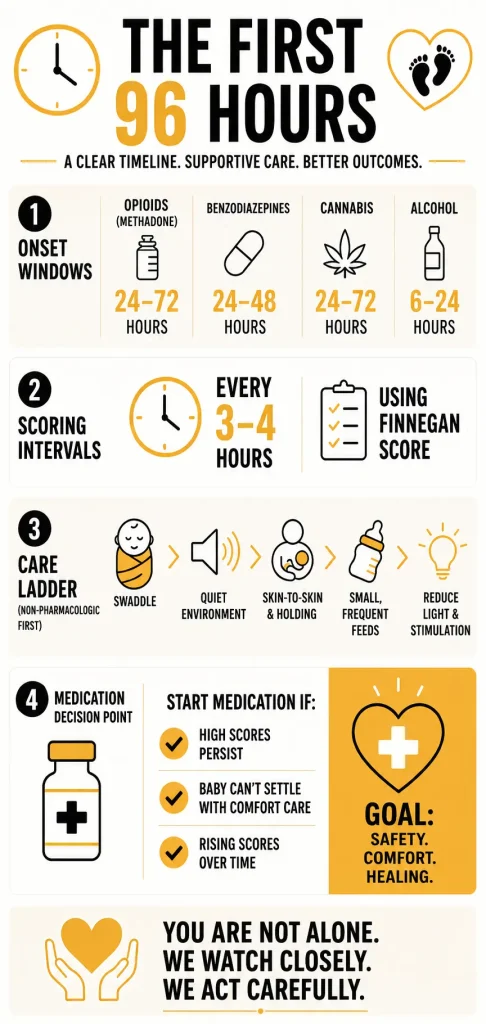
First Line: Rooming-In, Skin-to-Skin, Feeding
Treatment for newborn withdrawal does not always begin with medication.
In many cases, the first-line approach involves rooming-in and supportive care.
Rooming-in means keeping the newborn with the parent or caregiver rather than automatically moving the baby to a separate intensive care environment. When medically appropriate and supported by hospital policy, rooming-in may reduce environmental stimulation and give parents more opportunities to respond to the baby’s needs.
Supportive care can include:
- Skin-to-skin contact
- Swaddling
- Quiet, low-stimulation environments
- Gentle movement
- Frequent feeding
- Helping the baby sleep
- Promptly responding to crying
- Encouraging caregiver involvement
Couplet care is another term you may hear. It generally refers to caring for the mother and newborn together as a pair rather than separating them unnecessarily.
These approaches can be particularly helpful because newborn withdrawal may become more noticeable when a baby is overstimulated, hungry, or unable to settle.
Feeding is also an important part of care.
Breastfeeding eligibility depends on the individual circumstances. For mothers who are stable on prescribed methadone or buprenorphine and have no other contraindications, breastfeeding is generally encouraged. Individual breastfeeding eligibility should still be determined with the mother’s and baby’s healthcare teams, because factors such as current non-prescribed substance use, certain medications, infectious diseases, and the health of the mother and newborn can affect the recommendation.
For mothers taking methadone or buprenorphine as prescribed, breastfeeding can be an important part of newborn care when clinically appropriate. Discuss your specific situation with your obstetric and pediatric providers so they can account for your medications, health history, current substance use, and the baby’s medical needs.
Parents can ask before delivery:
- Will my baby room-in with me?
- Does the hospital use couplet care?
- Can I provide skin-to-skin contact?
- What are the hospital’s breastfeeding eligibility guidelines?
- Will I be involved in withdrawal assessments?
- What signs should I watch for?
Knowing the answers ahead of time can make the hospital experience feel more predictable.
When Medication Is Used, Length of Stay?
Supportive care is often the starting point, but some newborns continue to have symptoms that interfere significantly with eating, sleeping, or being consoled.
When symptoms cannot be adequately managed with non-pharmacologic care, the medical team may consider medication.
Common medications used for opioid withdrawal in newborns include opioid medications such as morphine. The exact medication and protocol vary by hospital and clinical circumstances.
If morphine is used, the goal is generally to control significant withdrawal symptoms while supportive care continues.
Once the baby’s symptoms are stable, clinicians may gradually reduce the medication. This process is often called morphine weaning.
Morphine weaning is not necessarily a sign that treatment is failing. It is part of the process of gradually reducing pharmacologic support while monitoring whether the newborn continues to function comfortably.
The length of stay can vary considerably.
Some babies who are monitored for NOWS may not require medication and can go home after an appropriate period of observation if they are feeding, sleeping, maintaining vital signs, and otherwise meeting discharge criteria.
Other newborns may need a longer hospitalization because of persistent symptoms or the need for medication treatment.
There is no single hospital stay that applies to every baby with NAS.
Length of stay can be influenced by:
Type and timing of prenatal exposure
- Gestational age
- Severity and persistence of symptoms
- Feeding ability
- Weight and hydration
- Whether medication is required
- Response to treatment
- Hospital observation policies
- Other medical conditions
Parents should therefore avoid comparing their baby’s hospital course with another family’s experience.
A longer stay does not automatically mean a poor long-term outcome, just as a short stay does not guarantee that every future developmental question has been answered.
What Outcome Research Does Not Show?
Parents understandably want a simple answer to one question:
“Will my baby be okay?”
Research cannot provide a guaranteed individual outcome from a diagnosis of NAS or NOWS.
Studies have found associations between prenatal substance exposure and certain developmental, behavioral, or health outcomes, but interpreting those findings is complicated.
Prenatal exposure is only one factor in a child’s life.
Researchers have to account for differences in socioeconomic circumstances, prenatal care, maternal health, polysubstance exposure, tobacco exposure, genetics, nutrition, family environment, education, and access to healthcare. Not every study can fully separate these factors.
That means it is not appropriate to take a population-level association and tell an individual parent that their baby will experience a particular outcome.
Likewise, a diagnosis of NAS does not provide a reliable prediction of a child’s intelligence, behavior, or future ability to succeed.
The research also does not support treating NAS as a moral score.
A baby can experience withdrawal and still have a healthy developmental trajectory. A parent can receive treatment for OUD throughout pregnancy and still need support after delivery. Both things can be true at the same time.
Some pregnant people with OUD who search for rehab for pregnant women are looking for a treatment setting that can support recovery while also coordinating with prenatal care and other medical needs. The most appropriate level of care depends on the individual’s clinical circumstances, stability, and available supports.
Treatment during pregnancy may include medication, counseling, behavioral healthcare, prenatal care, family support, and other services. The appropriate combination depends on individual needs.
Planning for Discharge and Beyond
Preparing for a baby with possible NOWS does not end when the hospital explains the withdrawal assessment.
Families may benefit from knowing what support will be available after discharge.
One concept that may come up is a Plan of Safe Care.
Under the federal Child Abuse Prevention and Treatment Act (CAPTA), states receiving certain federal child-protection funding must maintain policies addressing infants affected by prenatal substance exposure or withdrawal, including Plans of Safe Care. How notification, assessment, service coordination, and follow-up are handled can vary by state and by the family’s circumstances.
A Plan of Safe Care should not automatically be interpreted as a judgment about a parent’s ability to care for their child. It is intended to identify the health, treatment, and support needs of the infant and family and to help coordinate appropriate services.
Because CAPTA implementation is state-specific, parents should ask their hospital or healthcare team how notification and Plan of Safe Care requirements work where they live.
After discharge, ongoing pediatric appointments are important. Your baby’s provider can monitor feeding, weight gain, development, sleep, and other areas of health over time.
The mother also deserves continued care.
The postpartum period can involve significant physical and emotional changes. For someone with OUD, maintaining access to medication treatment and recovery support can be particularly important.
Family support can make a difference as well. Therapy can help parents navigate communication, stress, relationships, and the adjustment to life with a newborn.
If additional support is needed, addiction treatment programs can provide information about available treatment approaches. Family therapy may also be useful when substance use has affected relationships or when family members need help understanding recovery.
The goal is not to define a family by NAS.
The goal is to help the newborn recover from withdrawal when it occurs while giving the parent the support needed to continue recovery and provide a stable environment after discharge.
The Bottom Line
Neonatal abstinence syndrome is a medical condition that can occur after prenatal exposure to certain substances, particularly opioids. It is not a measure of a parent’s character, and it does not by itself predict a child’s future.
NAS and NOWS describe related but slightly different concepts, with NOWS specifically referring to opioid-related newborn withdrawal. Hospitals may use Finnegan scoring, Eat Sleep Console, or another assessment approach to monitor symptoms.
Treatment often begins with supportive care such as rooming-in, skin-to-skin contact, feeding support, and caregiver involvement. Family therapy can also provide additional support for parents and family members navigating the emotional and practical challenges surrounding newborn withdrawal. Some newborns require medication, followed by a gradual morphine weaning process or another hospital-specific protocol.
Hospital stays vary. So do recovery experiences.
If you are pregnant and concerned about opioid exposure, methadone, buprenorphine, or another medication, talk with your obstetric and pediatric healthcare teams. If you are considering methadone or suboxone while pregnant, do not make medication changes solely because you are worried about NAS.
For parents who need additional recovery support, treatment options—including programs designed to support pregnant women and families—can provide a path forward.
A diagnosis of NAS is one part of a newborn’s medical history. It does not define the baby, the parent, or the family’s future.