

If you’re pregnant and looking into rehab for pregnant women in California — whether that means a full drug detox program or ongoing outpatient support — there’s a good chance the question stopping you from calling anyone isn’t “will this work” — it’s “will this get reported.” That fear is common; it’s not irrational, and it deserves a straight answer instead of the vague warnings that tend to circulate.
The short version: seeking treatment is not what triggers a report. California law is built around a distinction between disclosure, medical monitoring, and a legal action — and the three get conflated constantly. This post walks through what state and federal law actually set up, where hospital policy varies from that baseline, and why the honest answer to some of your specific questions is “ask your provider and, if you want certainty, ask an attorney.”
This article explains general California and federal policy. It is not legal advice, and it doesn’t replace a conversation with your OB, a hospital social worker, or a licensed attorney about your specific situation — the section below on hospital variation and the closing section both come back to that point because it matters more than any other in this piece.
The Short California Answer, Up Front
Under California law, pursuing rehab for pregnant women — whether that’s detox, outpatient counseling, or medication assisted treatment like Suboxone while pregnant — is not, by itself, a reportable event. Treatment programs operate under substance use confidentiality protections, and asking for help is the behavior every relevant policy is designed to encourage, not punish.
Separately, California Penal Code Section 11165.13 — part of the state’s Child Abuse and Neglect Reporting Act (CANRA) — states directly that a positive toxicology screen at the time of delivery is not, on its own, a sufficient basis for a child abuse report. It can prompt a needs assessment of the mother and infant, and depending on what that assessment finds, a report may follow. But the test result by itself isn’t the trigger.
That’s the general rule. Where things get more specific — what a particular hospital does at intake, how a given county’s child welfare agency handles a Plan of Safe Care, what happens if other risk factors are present — depends on details this article can’t know about your situation. The rest of this piece explains the mechanics behind that general rule so you can ask better questions, not so you can predict your own outcome from it.
It’s also worth naming why this fear is so sticky in the first place. Stories about pregnant women losing custody after a single positive test circulate widely, and some of those stories are accurate accounts of what happened somewhere, at some point, under some hospital’s protocol. What they usually don’t include is the statutory language that was supposed to prevent a lab result alone from carrying that much weight, or the difference between a state with a punitive approach to prenatal substance exposure and California’s stated policy framework. Both things can be true at once: the written law leans toward support and assessment rather than automatic punishment, and individual outcomes have still, in some documented cases, diverged from that framework. That gap is part of why the sections below spend so much time on hospital-level variation and on recommending a direct conversation with an attorney if your situation has any added complexity.
A Positive Tox Screen Alone Is Not a Report
CANRA is California’s mandated reporting law, and it applies broadly to healthcare workers, educators, and other professionals who work with children. Most people assume any positive drug test during pregnancy automatically feeds into this system. The statute doesn’t work that way.
As referenced above, Section 11165.13 specifically carves out toxicology results at delivery: a positive screen requires an indication of maternal substance use to prompt an assessment of the needs of mother and child, and it’s the results of that broader assessment — not the lab result in isolation — that determines whether a report to child welfare is warranted. In practice, this generally means providers are supposed to be looking at the whole picture: prenatal care engagement, whether the mother disclosed substance use, whether she’s connected to treatment, and other indicators of risk to the child — not treating a single test result as conclusive on its own.
This matters directly for anyone weighing rehab for pregnant women or already on medication like buprenorphine or methadone. A positive test for a prescribed, medically supervised medication is a different clinical and legal picture than an unmonitored positive for an illicit substance, and providers who understand current guidance from ACOG on treating opioid use disorder in pregnancy generally document that distinction. Being in treatment, or actively seeking rehab for mothers who are pregnant or postpartum, is evidence of engagement with care — the opposite of the risk factor a report is meant to catch.
It’s also worth knowing what ACOG recommends happens earlier in pregnancy, before delivery: verbal screening for substance use at prenatal visits, rather than routine, non-consensual drug testing of every patient. Verbal screening is a conversation-based tool, not a lab test, and it’s the front-line approach ACOG endorses for identifying patients who might benefit from a referral to treatment.
The logic behind favoring verbal screening over blanket testing is straightforward: a conversation can lead somewhere useful — a referral, a treatment plan, ongoing monitoring — in a way a surprise positive lab result can’t undo after the fact. It also reduces the odds that someone avoids prenatal care altogether out of fear of being tested, which is its own, separate risk to the pregnancy. None of this means testing never happens; it means the recommended starting point is asking, not testing everyone by default.
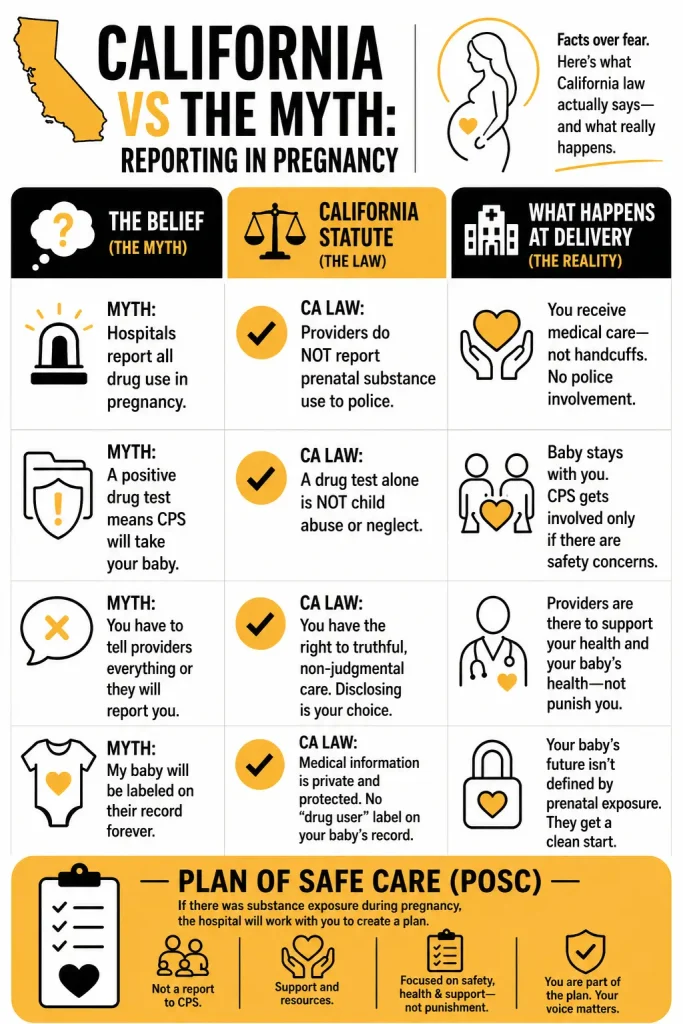
CAPTA Notice and Plan of Safe Care
Separate from CANRA, there’s a federal layer: the Child Abuse Prevention and Treatment Act (CAPTA), amended by the Comprehensive Addiction and Recovery Act (CARA). CAPTA requires states receiving certain federal funding to have a system in place for identifying infants affected by prenatal substance exposure and connecting them — and their families — to a Plan of Safe Care.
A Plan of Safe Care is not a removal order. It’s meant to function as a coordinated support plan: pediatric follow-up, connections to outpatient treatment, and other services intended to support the family after discharge. CAPTA notification is generally tied to the infant showing signs consistent with prenatal substance exposure — things like documented withdrawal symptoms — rather than to a parent’s history of having sought treatment or being prescribed medication for opioid use disorder.
Hospitals identify substance-exposed infants through a few different methods, and it’s useful to know the vocabulary even though the specific method used varies by facility: meconium testing (testing the newborn’s first stool, which reflects exposure over roughly the last several months of pregnancy) and cord testing (testing umbilical cord tissue) are the two most common newborn toxicology methods, alongside maternal history and verbal screening. Which method a hospital uses, whether it tests universally or only when risk factors are present, and what informed consent process surrounds that testing are all questions where policy differs by hospital and where California’s own rules have been actively evolving — which is exactly the kind of detail worth confirming directly with the hospital where you plan to deliver, rather than assuming a single statewide standard.
Hospital Policy vs. State Law, What to Ask
This is the section where a lot of the anxiety around rehab for pregnant women actually lives, and it’s also the section where this article is most limited in what it can tell you with confidence — because hospital policy is not the same thing as state law, and the two don’t always move together.
State and federal law set a floor: what CANRA requires, what CAPTA requires, when a Plan of Safe Care applies. Individual hospitals build their own protocols on top of that floor, and those protocols can differ meaningfully in practice — universal versus risk-based newborn testing, how explicitly informed consent is obtained before a maternal or newborn drug screen, how quickly a positive result gets escalated internally, and how a hospital’s social work team frames a Plan of Safe Care conversation with a new parent.
Rather than guess at what your specific hospital does, these are reasonable questions to bring to your OB or a hospital social worker before delivery:
- Does this hospital test all newborns for substance exposure, or only when there’s a specific clinical indication?
- What testing method does this hospital use — meconium, cord tissue, or something else — and is informed consent obtained before a maternal drug screen?
- If I’m in treatment and disclose that to my care team, what happens with that information internally?
- What does this hospital’s Plan of Safe Care process actually look like, and who’s involved in it?
Getting concrete answers to these questions before you’re in a delivery room removes a lot of the guesswork that fuels the fear in the first place.
Where Outpatient Fits Without Detox?
Not every pregnant person considering treatment needs inpatient drug detox, and for many people already stable on medication assisted treatment, an outpatient structure is the more appropriate — and less disruptive — level of care. If you’re managing opioid use disorder with Suboxone while pregnant and don’t need a medically supervised drug detox, a structured outpatient program can provide counseling, group support, and monitoring without requiring you to step away from work, prenatal appointments, or family responsibilities.
A partial hospitalization program is one option worth understanding here: it offers a higher level of structure and clinical support than standard outpatient counseling, while still allowing you to return home each day. For someone weighing rehab for pregnant women against the practical realities of pregnancy — appointments, transportation, other children, work — that middle level of care is often what actually fits.
This distinction also matters for how treatment interacts with everything discussed above. A pregnant patient engaged in a licensed outpatient or partial hospitalization program has an ongoing clinical relationship, documentation of consistent care, and a treatment team that can speak to her engagement if questions ever come up around delivery. That’s a meaningfully different starting point than showing up at a hospital for the first time during labor with no prior treatment history — not because one path is judged and the other isn’t, but because continuity of care is part of what a needs assessment under CANRA is designed to weigh. Rehab for mothers who are pregnant or newly postpartum doesn’t have to mean stepping away from daily life to get that continuity in place.
If you’re unsure what level of care makes sense for where you are, our admissions team can talk through your situation and help match you with the right program rather than defaulting to the most intensive option available.
Confirm With a CA Family Law Attorney
Everything in this article describes general California and federal policy as it’s written. It is not a substitute for legal advice about your specific circumstances, and it can’t account for
Frequently Asked Questions
Do rehabs report pregnant patients?
No. Seeking or participating in rehab while pregnant does not, by itself, trigger a report to child welfare in California. Treatment programs operate under substance-use confidentiality protections, and getting help for substance use is not itself a reportable event. However, other circumstances involving a pregnancy, delivery, hospital assessment, or child welfare concerns may lead to additional steps, so your specific situation should be discussed with your healthcare provider or a California family law attorney.
Does a positive test mean removal?
No. A positive toxicology test at delivery does not automatically mean that a baby will be removed or that a child abuse report will be made. Under California law, a positive toxicology result alone is not sufficient to establish the need for a child abuse report. Instead, the needs of both the mother and infant are assessed, and other factors may be considered. A Plan of Safe Care may also be used to connect the family with appropriate medical, treatment, and support services.