

The math is what stops many mothers before they even call. Thirty days in residential treatment can mean someone else handling school pickup, changes to the family routine, and difficult questions about how treatment will affect parenting for many women, that can make rehab feel impossible. But delaying treatment can allow a substance-use problem to continue.
Rehab for mothers does not always mean leaving home for a residential program. Outpatient levels of care, including intensive outpatient programs (IOP), partial hospitalization programs (PHP), and virtual IOP, can provide structured treatment while allowing a mother to return home after treatment sessions. The right level of care depends on a clinical assessment and the person’s individual needs.
This guide explains what outpatient treatment can look like for a mother who needs recovery support while also managing parenting, work, school schedules, and childcare.
This post is part of our Motherhood and Recovery series. For related reading, see our guide to Virtual IOP and accepted insurances.
Outpatient Treatment Does Not Automatically Mean Losing Custody
One common reason mothers delay treatment is fear that asking for help will automatically lead to a CPS report or a change in custody. Choosing outpatient care does not, by itself, determine a custody outcome. Parenting and child-safety decisions depend on the specific facts of the family and, when applicable, the court or child-welfare agency.
Seeking treatment may help demonstrate that a parent is taking steps to address a substance-use problem. A clinical assessment, consistent participation, and a documented treatment plan can provide evidence of treatment engagement. However, those records do not guarantee a particular result in a custody or CPS matter.
Outpatient care can also make it easier for some mothers to maintain an existing parenting routine because IOP and PHP do not require an overnight stay. A mother may be able to return home after treatment sessions and continue school, work, and family responsibilities, depending on her clinical needs and available support.
If you are involved in an active custody case, a CPS matter, or an existing court order, a California family law attorney can help explain how treatment could interact with your specific situation.
What Is IOP?
What is IOP? Intensive Outpatient Program, commonly called IOP, is a structured level of addiction treatment that allows a person to receive several hours of care each week without staying overnight. IOP is associated with ASAM Level 2.1 and may include group therapy, individual counseling, education, and recovery planning.
For mothers, the main advantage of IOP is scheduling flexibility. Many programs organize sessions across several days each week, and some offer evening or virtual options. This can make it possible to coordinate treatment with school drop-off, pickup, work, and childcare.
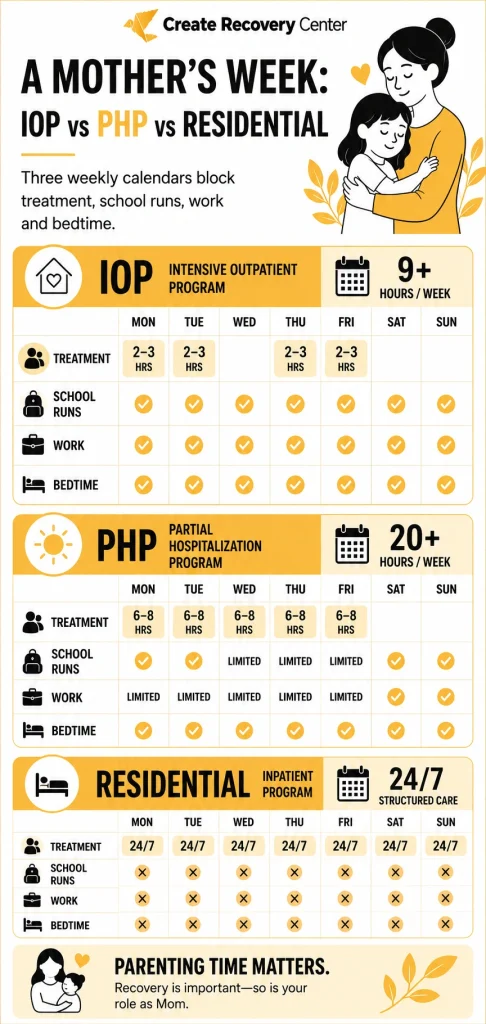
A typical IOP schedule may involve approximately 9 to 12 hours of treatment per week, often divided across three days. Exact schedules vary by program and clinical needs.
IOP vs. PHP vs. Virtual IOP
The appropriate level of outpatient treatment is based on a clinical assessment rather than simply on what is most convenient. IOP, PHP, and virtual IOP can differ substantially in intensity and scheduling.
| Level | Typical structure | Parenting considerations | Potential fit |
| IOP (ASAM 2.1) | Several hours per day across multiple days each week | May leave substantial time for work, school, and parenting | People who need structured treatment without daily full-day programming |
| PHP (ASAM 2.5) | More intensive programming, often five days per week | May require childcare or help with school pickup | People who need more structure than IOP provides |
| Virtual IOP | IOP delivered through telehealth when clinically appropriate | Can reduce commute time and make childcare logistics easier | People for whom remote treatment is appropriate |
IOP Los Angeles: Building Treatment Around a Mother’s Schedule
For mothers searching for IOP Los Angeles, scheduling is often one of the first practical questions. A program may offer morning, afternoon, evening, or virtual sessions, depending on its services and clinical requirements.
Before enrolling, ask about the weekly schedule, attendance expectations, individual sessions, family services, telehealth availability, and what happens if a parenting responsibility conflicts with a treatment session.
For a mother with school-age children, an IOP schedule might look like this:
- Monday, Wednesday, and Friday: school drop-off, morning IOP, return home, then work or family responsibilities.
- Tuesday and Thursday: regular parenting and work days, depending on the treatment plan.
- One additional evening: an individual therapy or counseling appointment, if included in the program.
This is only an example. Actual treatment schedules vary, and a clinical team may recommend a different structure based on withdrawal risk, mental health needs, substance use, and the amount of support required.
Outpatient Rehab Los Angeles: What to Ask Before You Enroll
When comparing outpatient rehab Los Angeles programs, mothers may want to ask practical questions before scheduling an assessment. The goal is to find a program that meets clinical needs while making the family schedule manageable.
- What level of care does the clinical assessment recommend?
- How many hours per week are required?
- Are morning, evening, or virtual sessions available?
- How are missed sessions handled?
- Does the program offer individual or family therapy?
- Can the program provide attendance or participation documentation when appropriate?
- What childcare or transportation planning should be completed before treatment begins?
Convenience should not be the only factor. If someone needs a higher level of care, choosing a lower level solely to preserve a schedule may not provide enough clinical support. The treatment team should determine the appropriate level based on the person’s condition and recovery needs.
A Week Built Around Pickup and Childcare
The practical difference between IOP and PHP can be significant for a mother. An IOP schedule may leave more hours available for school pickup and parenting, while PHP can involve treatment most weekdays and therefore require another caregiver to cover some responsibilities.
Before starting treatment, make a simple childcare plan. Identify who can handle school pickup, transportation, meals, homework, and unexpected schedule changes. If there is no reliable backup, ask the treatment program whether it offers virtual services or alternative scheduling when clinically appropriate.
The objective is not to make treatment fit at any cost. It is to create a realistic plan that allows the mother to participate consistently while keeping children safe and supported.
What You Tell Work, School, and Your Kids
Work. Eligible employees may have job-protected leave available under federal or California leave laws, but eligibility and documentation requirements vary. Speak with HR or an employment attorney before assuming that a particular leave protection applies.
School. In many situations, a school only needs operational information such as a change in pickup person or after-school arrangements. A parent can decide what personal information is appropriate to share.
Kids. What to tell children depends on age, maturity, family circumstances, and the mother’s preferences. A family therapist can help develop age-appropriate language without making children responsible for the parent’s recovery.
Treatment Records and the Paper Trail
Outpatient treatment creates healthcare records. Privacy protections may apply to those records, but mothers should not assume that treatment information can never be disclosed or become relevant to another proceeding. Access and disclosure depend on applicable privacy laws, authorizations, insurance processes, and other circumstances.
If treatment documentation later becomes relevant to a custody matter, attendance records, treatment plans, or completion documentation may help establish participation. Whether particular records help or hurt depends on the facts of the case and should be discussed with a California family law attorney.
Insurance and the Paper Trail You Control
Outpatient treatment may involve insurance authorization and utilization review. Before treatment begins, ask the program and insurer about benefits, authorization requirements, copays, and the expected level of care.
Keep copies of documents you are entitled to receive, such as benefit information and billing statements. If you have an active legal matter, ask your attorney which treatment documentation is appropriate to maintain or provide.
First Week: Intake to Treatment Plan
- Day 1: Clinical assessment. The treatment team evaluates the appropriate level of care and identifies immediate needs.
- Days 2–3: Insurance verification and scheduling. The program works through benefits, session times, and treatment logistics.
- First week: Groups and individual services begin according to the treatment plan.
- Ongoing: The treatment team reassesses progress and determines whether the current level remains appropriate.
If withdrawal symptoms, mental health concerns, or other clinical issues require more intensive support, the treatment team may recommend a different level of care. Stepping up or down in treatment intensity can be part of an individualized recovery plan.
Getting Started
Rehab for mothers works best when treatment is clinically appropriate and the family logistics are realistic. That may mean IOP three mornings a week, virtual IOP from home, or PHP while a family member covers school pickup.
The goal is not to choose the least intensive treatment simply because it is easier to schedule. The goal is to receive the appropriate care while building a safe and sustainable plan for parenting, work, and recovery.
Frequently Asked Questions
Can I do rehab and raise my kids?
Yes, outpatient treatment can allow many mothers to continue parenting at home while receiving care. IOP and PHP do not require an overnight stay, although PHP may require more childcare because of its heavier schedule. Whether you can remain the primary caregiver during treatment depends on your clinical needs and family circumstances.
How many hours a week is IOP?
IOP commonly involves about 9 to 12 hours of treatment per week, often spread across three days, although schedules vary by program. PHP is generally more intensive and may involve treatment on most weekdays.