

Will I lose custody if I go to rehab? It’s the question that keeps a lot of mothers from calling a program at all, even when they know they need help. The fear makes sense on the surface: courts decide who gets to raise a child, and admitting you have a substance use problem feels like handing them a reason to say no.
But California family court doesn’t work off fear; it works off a specific legal standard. This guide walks through what a judge actually weighs when a parent has been, or is currently, in treatment — and where the real risk lies, since it’s rarely where mothers expect it.
Rehab is not grounds to lose custody
Going to rehab does not automatically mean you will lose custody or parenting time. California custody decisions focus on the child’s best interests and the circumstances affecting the child’s health, safety, and welfare. Treatment itself is not the same thing as a finding that a parent is unable to safely care for a child.
What can affect a custody outcome is the underlying substance-use problem, how it has affected the child or parenting responsibilities, and what steps the parent is taking to address any concerns. Voluntarily seeking treatment can be relevant evidence that a parent is taking action, but how that evidence is weighed depends on the facts of the individual case.
It helps to separate two situations that can look very different in a mother’s mind. The first is a parent who voluntarily seeks treatment before any court case is underway. The second is a parent already involved in a contested custody matter, where a co-parent or the court has raised concerns. In the first situation, treatment by itself does not determine custody. In the second, treatment can become one piece of the evidence the court considers alongside the concerns that led to the dispute and the parent’s response to them.
How best-interest factors read treatment
Every California custody decision runs through Family Code 3011, the statute that defines the best interest standard judges must apply. Section 3011 directs the court to consider the health, safety, and welfare of the child, along with any history of habitual or continual substance abuse by either parent, among a broad list of relevant factors.
Notice what the statute asks the court to consider: the child’s health, safety, and welfare, along with relevant circumstances such as a parent’s history of habitual or continual substance abuse. A treatment admission is only one piece of the overall picture. The court may consider whether a parent has recognized a substance-use concern, sought appropriate treatment, followed recommendations, and maintained safe and consistent care for the child.
If a custody evaluation is ordered in a contested case, the evaluator may consider the parent’s current functioning, the child’s needs, and other relevant information. Minor’s counsel, when appointed to represent the child’s interests, may also consider information relevant to the child’s welfare. The specific issues considered will depend on the circumstances of the case.
What a judge weighs: attendance, testing?
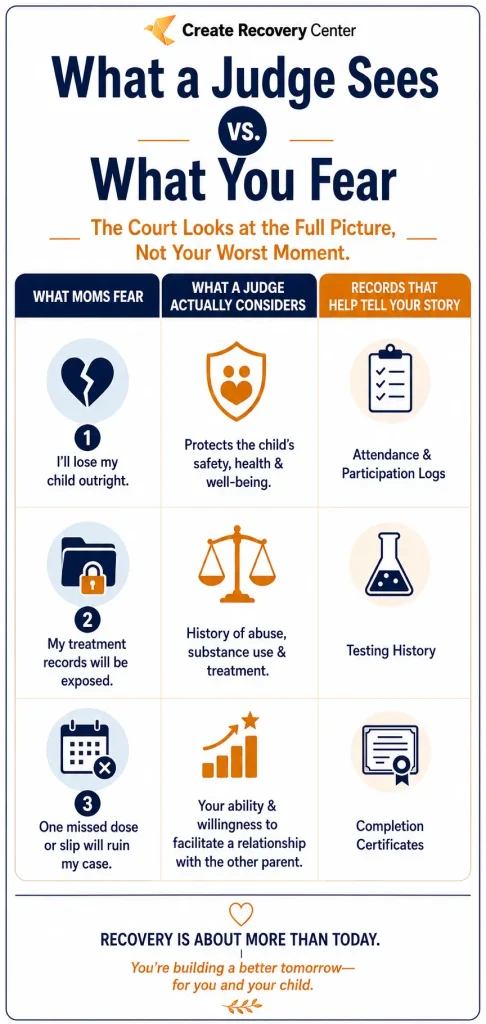
Where treatment does become relevant in a custody case, it’s usually because a parent’s engagement with it is being used as evidence of stability, not instability. Judges and evaluators commonly look at:
- Attendance logs from the program, showing consistent participation rather than sporadic or abandoned treatment
- Testing results, when relevant, showing a pattern of compliance over time rather than a single snapshot
- Program completion or ongoing active enrollment, as opposed to starting and quietly dropping out
- Aftercare and continuing support, which signals a parent is building a sustainable recovery, not checking a box
Consistent attendance, completion, testing when appropriate, and continued aftercare can provide useful evidence that a parent is actively addressing a substance-use concern. How much weight the court gives that evidence will depend on the circumstances of the case.
Real risk: no-shows and untreated relapse
The actual custody risk in these cases rarely comes from rehab itself. It comes from what happens around it: missed appointments, an untreated relapse that affects a child’s day-to-day care, or a pattern of starting treatment and disengaging before it takes hold. A judge who sees repeated no-shows, or who receives evidence of a relapse that went unaddressed while a parent had custodial responsibility, has real cause for concern under Family Code 3011.
For a mother wondering, “will i lose custody if i go to rehab,” the more important question is often what happens when a substance-use problem remains untreated and begins affecting the child’s day-to-day care.
This is also where a court may order monitored visitation — supervised parenting time — if the court finds that additional safeguards are appropriate while a parent addresses an unresolved safety concern. The purpose and duration of monitored visitation depend on the circumstances and the court’s orders; it should not be presented as an automatic consequence of going to rehab.
In other words: the danger isn’t the rehab enrollment on your record. The danger is an unmanaged pattern that a judge has no evidence you’re addressing.
It is also worth understanding how these concerns can reach the court in the first place. A co-parent may raise concerns in a filing, a school or third party may identify a safety issue, or information may surface during an already-open custody dispute. Documentation can help a parent explain the steps they have taken, including treatment participation, attendance, and aftercare, if those records are properly available for use in the case.
Why outpatient protects parenting time?
For some mothers, outpatient treatment can make it easier to continue an existing parenting schedule while receiving care. Depending on the program’s schedule and the parent’s clinical needs, outpatient treatment may allow a parent to remain involved in school pickups, bedtime routines, and other day-to-day responsibilities that could be interrupted by a residential stay. For mothers considering rehab for mothers, an outpatient schedule may be worth discussing with the treatment provider. It does not, however, guarantee that parenting time or custody will remain unchanged.
Outpatient programs built around family involvement matter here too. A program that incorporates family therapy alongside individual treatment gives a parent something concrete to point to: not just personal recovery, but active work on the parent-child relationship and household stability that a best-interest analysis directly considers.
If a case is already in FCS mediation, bringing documentation of an active treatment plan, attendance, and ongoing engagement can give the mediator concrete information about the steps you are taking. The mediator’s role is different from the court’s, and the effect of that information will depend on the circumstances of the case.
Have a CA family law attorney review
Everything above describes the general standard. It is not a substitute for advice on your specific case, especially if a custody matter is already open, a prior incident is in your file, or a co-parent is raising your treatment history in court. Sometimes rehab is entered voluntarily; other times a parent is navigating court ordered rehab as part of an existing case, and the strategic considerations are different in each situation.
Before choosing a program, you can also speak with admissions about the treatment schedule, documentation, and practical arrangements that may affect your parenting responsibilities.
A California family law attorney can help you understand how your treatment records may be used, whether 42 CFR Part 2 protections apply to your specific program and consent forms, and what documentation may be appropriate in your circumstances. This is a conversation worth having before you enroll if you are already involved in a custody dispute or expect your treatment history to become relevant to the case.
If you’d like help thinking through the right program for your situation, you can start with a confidential intake conversation and get specific questions answered directly.
Frequently Asked Questions
Can rehab be used against me?
Rehab itself does not automatically determine a custody outcome. Treatment records covered by 42 CFR Part 2 receive specific confidentiality protections, subject to applicable consent requirements and legal exceptions. If treatment information is properly before the court, evidence such as attendance, completion, testing, or aftercare may be considered along with the other facts of the case. Consistent participation may help demonstrate that a parent is addressing a substance-use concern, but it does not guarantee a particular custody outcome.
Will the court see my records?
Not automatically. 42 CFR Part 2 provides specific confidentiality protections for covered substance-use-disorder treatment records and generally requires patient consent or another applicable legal exception for disclosure. Depending on the circumstances, those exceptions can include certain court processes or disclosures required by law. If you are involved in a custody case, ask your attorney and treatment provider how Part 2 applies to your specific records, releases, and circumstances.
Will I lose custody if I go to rehab?
Going to rehab does not automatically mean you will lose custody. California custody decisions consider the child’s best interests and the circumstances affecting the child’s health, safety, and welfare. Voluntarily seeking treatment may be relevant evidence that a parent is taking steps to address a substance-use concern, but the effect of treatment on custody depends on the facts of the individual case.
What is the best interest standard, exactly?
It’s the legal framework under Family Code 3011 that every California custody decision runs through. It requires the court to weigh the health, safety, and welfare of the child, along with a range of other factors including any history of habitual substance abuse, in deciding what custody and visitation arrangement serves the child best.
Does a custody evaluation automatically follow a rehab stay?
No. A custody evaluation is typically ordered only in contested cases where the court needs an independent assessment, not as a routine consequence of treatment. Many parents complete rehab without any evaluation ever being ordered.
What if my case is already in FCS mediation?
Bring documentation if you have it. An active treatment plan, attendance records, and evidence of ongoing participation can give the mediator concrete information about the steps you are taking. FCS mediation and a judge’s custody determination are different processes, so documentation does not guarantee a particular recommendation or outcome.